Showing posts with label norway. Show all posts

Friday, May 8, 2026

Paranormal Folklore, Angrboða Mother of monster's...


Angrboda, Wife of Loki and  Mother of Monsters. 

The name Angrboða first  appears in the Poetic Edda (Völuspá hin skamma) and is later detailed in Snorri Sturluson's Prose Edda in the 13th century.

She's from Jötunheimr, the land of giants.

In Norse mythology Angrboða is the giant wife of Loki,  she gave birth to Jörmungandr, the world serpent, Hel, ruler of the dead, and Fenrir, the ferocious giant wolf. All key figures in Ragnarök ( the end of the world).

Though she is the embodiment of motherly love, caring greatly for each of her children even though  all of them are monstrous  creatures that will eventually take part in the end of the world and death of the Norse pantheon. She is still a kind mother 


Her name means She who brings grief" or "messenger of sorrow," because of the tragic role her children will eventually bring.

......


She is only mentioned once in the Poetic Edda (Völuspá hin skamma) as the mother of Fenrir by Loki. The Prose Edda (Gylfaginning) describes her as "a giantess in Jötunheimar" and as the mother of three monsters: the wolf Fenrir, the Midgard serpent Jörmungandr, and the ruler of the dead Hel.


The Children......

🔥👱‍♀️🐺🐍🔥


,....


🏵️Happy Mother's Day Weekend🌸


Wednesday, December 24, 2025

The Jul Goat.


The origins of the  Yule Goat (Christmas goat) are lost to history at this point, but one of the main  theory is that the celebration of the goat is connected to worship of Thor the Norse god of thunder, who rode across the sky in a chariot pulled by two goats, Tanngrisnir and Tanngnjóstr;


Another one is that  it goes back to common Northern European beliefs. The last sheaf of grain bundled in the harvest was credited with magical properties as the spirit of the harvest and saved for the Yule celebrations, called among other things Yule goat (Julbocken).


This connects to ancient proto-Slavic beliefs where the Koliada (Yule) festival honors the god of the fertile sun and the harvest. This god, Devac (also known as Dazbog or Dažbog), was represented by a white goat, consequently the Koliada festivals always had a person dressed as a goat, often demanding offerings in the form of presents.

A man-sized goat figure is known from 11th-century remembrances of Childermas, where it was led by a man dressed as Saint Nicholas, symbolizing his control over the Devil.

In Sweden, people believed the Yule goat to be  an invisible spirit that would travel from home too home some time before Christmas to make sure that the Yule preparations were done properly.

Small goat figures made out of straw or wood could also be called the Yule goat, and in older times people would play  a popular Christmas prank by hiding one of these mini Yule goats in a neighbour's house without them noticing; the family successfully pranked had to get rid of it in the same way.

The function of the Yule goat has changed over time , In a Scandinavian custom similar to the English tradition of wassailing (singing Christmas carol's), held at either Christmas or Epiphany, young men in costumes would walk between houses singing songs, enacting plays and performing pranks. This tradition is known from the 17th century and still continues in certain areas. 

The group of Christmas characters would often include the Yule goat, a rowdy and sometimes scary creature demanding gifts...

...........


Ever wish you could trick or treat in December? If you live in Scandinavia you can,kind of..


Norway Julebukk -Julbok - Julebukking is basically a Christmas version of trick-or-treating the tradition dates back centuries.

During Julebukk people dress up as goats, trolls, or other mythical creatures to sing and perform for their audiences. And gain rewards ( candy or other sweets). The old notes version of this was a man dressed in goat skins caring a goat heat and crashing other people's party's...today's version is much nicer.

The origins of Julebukk can be traced back to pre-Christian times, when goats were associated with the Norse god Thor and were thought to have magical powers. The tradition was also a way to celebrate the winter solstice and a way to engage and wish good luck and happiness to the community.

Today, Julebukking tradition is still popular in Norway, and many families and communities participate in the practice during the Christmas season. The performances typically involve singing, dancing, and storytelling, and often include traditional Christmas songs and folktales. The Julebukk costumes can be elaborate and creative, with participants dressing up in goat masks, horns, and other goat-like attire... Sometimes the people visited are supposed to join in the singing as they visit the next house, though this is optional...


.....


Yule Goat and Santa...


During the  1800's the Yule goat's became more like a Scandinavia Santa, bringing presents on Christmas.


Usually one of the men in the family would  dressing up as the Yule goat. (Modern day celebration Still dose this but as Santa)

Another old Norse version of Santa was the all father(Odin) riding around on his multi legged horse leaving gifts for good kids, this also ties into the wild hunt.

The goat was  eventually replaced by the jultomte (Sweden)  or julenisse (Norway) during the second half of the 19th century and early 20th century, although he is still called the Joulupukki (Yule goat) in Finland, and the tradition of the man-sized goat is no longer used now .


........


Swedish Yule Goat celebration..


This modern version of the Yule goat figure is a decorative goat made out of straw and usually bound with red ribbons, a popular Christmas ornament often found under or on the Christmas tree or larger visions used as laws decor for the holidays. 


Large versions of this ornament are frequently erected in towns and cities around Christmas time; a tradition started with the Gävle goat in 1966.


Though people often try to damage or burn it prevent this the ornament is often  guarded. This has resulted in more creative attempts to burn it down.


The town has tried lots of different ways to protect their goat. They’ve had guards stationed, security cameras put up and fences raised. And the goat itself has been sprayed with water and flameproof chemicals. Some years the goat even survives the whole holiday season! But most years … it doesn’t.

In 2005, a group dressed as Santa and gingerbread men fired flaming arrows into the goat. Hackers in 2009 disabled the security cameras and set the goat on fire. An American tourist was arrested for burning down the goat in 2001. He said he’d been told by his Swedish friends that burning the goat was OK. He ended up spending two weeks in jail.

And several other attempts, unfortunately trying to destroy it had become somewhat of a Tridition as well..


🎄Merry Christmas 🎄


And Happy New Year

🎆🎇🎆🎇🎆🎇🎆🎇🎆


Wednesday, February 19, 2025

Viking Folklore: Margygr


Viking Folklore: Margygr the Norse mermaid.
🛶🧜‍♀️🌊

In Norse mythology, the margygr is a large mermaid like creature that's believed to live off the coast of Greenland.
Unlike later mermaid legends where the mermaid is beautiful,  this creature is described as either unnerving and hideous or strikingly beautiful both and forms always leaves it's witness's in aw/shock.


Like most mermaid sightings the Margygr is a human fish hybrid, most of the time she has the top half of a beautiful  large breasted long haired woman with webbed hands with a fish like appearance from the waist down, though she is much larger then a normal mermaid. 

In other accounts she's described as a giant terrifying and grotesque creature.
 Margygr translates to "Sea Giantess" or "Sea spirit". 

The Vikings considered these being to be more of a force of nature or powerful spirit then an actual creature, some would even pray to it for a safe voyage before they set sail. 
Sightings are rare,but when it is  spotted it's always  before a powerful storm and can be either beneficial and helpful to sailors or harmful and violent.  . 


🌊🧜‍♀️🌊

Friday, February 14, 2025

skogsrå, the Foxy forest nymph


The northern forest's of Scandinavia are cold and dark, they are also home to many mysterious creatures Gnomes, Trolls, Giants, elves ect.


But there's another creatures that haunts these wood, as deadly as she is beautiful...

The skogsrå.

The skogsrå is a swedish version of the huldra.


,............

She most often  appears as a beautiful young woman with  a friendly attitude. 


From the front she looks like a normal woman but  from behind she usually has ether a fox or cow tail sicking out of her skirt/dress and a hollow back (but not always).


More often than not, the men that follow her into the forest are never seen again.

 In some folktales any man  that had sex with her and returned would be like a hollow shell of his former self as his soul remained with her.

 However if the  man is a hunter or someone that was kind to her, he may be rewarded with good luck in the hunt or fishing trip but should he ever be unfaithful to her, he will be struck with extreme bad luck and  accidents. In some cases the bad luck may end if the hunter fires a shot into the woods.

 Nyland, Finland Folklore says firing  silver bullets  can kill a skogsrå


In Norway, the word huldrefolk or huldre (plural)  comes from Old Norse huldr meaning ‘hidden’ it's used for all kinds of supernatural creatures. Hulder, or Huldra in the singular, signifies a female forest spirit, though she may also appear in mountains.


 These forest spirits act alone, instead of in.large group's or families like other supernatural beings, like the vittra. In northern Sweden, the name vittra refers to a group of supernatural beings that lives underground that have many traits in common with fairies from folklore of the British Isles, as well as with the ellefolk in Danish tradition or the huldrefolk /Hilda folk in Norwegian tradition.     


 Finland also has a version of the Huldra/ skogsrå, Some names in the Finnish language, mainly from the west coast, also show a link to the Swedish traditions, metsänpiika ‘forest girl’ or metsänneito ‘forest maid’ are the most often used names for the female forest spirit. However, there are also other localised names such as haapaneitsyt ‘aspen-maid’ or sinipiika ‘blue maid’.          


Her other Swedish names are  skogsrå, skogsrådan, skogsråa ‘forest ruler’, råan, rådande ‘the ruler,/the ruling spirit’, skogsjungfru ‘forest maiden’, skogsfru, skogssnuva ‘forest woman’, skogskäringen ‘the forest hag’, or with a nickname such as Grankotte–Maja ‘Spruce cone-Maja’, Talle-Maja ‘Pine tree-Maja’. She is also known by many different local variants like.. Gonna, Besta, Rånda, Skogela, Lanna-frökna ‘The lady of Lanna’ or Ysäters-Kajsa ‘Kajsa of Ysäter’. On the island of Gotland, there are records of a female troll called Torspjäska that plays the same role and has the same function as forest spirit on the mainland.      Germany has a legend of a long-haired beautiful fores spirits too,.  Called  Holzfräulein ‘the tree lady’, who was dressed in leaves, or as Moosweiblein ‘the moss woman’. 


If you're heading into the woods soon, be weary of any beautiful strangers that may approach you ...... 


 🖤💕Also Happy Valentines Day.💕🖤


Wednesday, October 30, 2024

Scandinavian Folklore: Mara.👻


The Mara is a female spirit like being from Scandinavian mythology.


One of the earliest mention and possibly the original origins of the tale comes from the Norse Ynglinga saga, a 13th century saga written by Snorri Sturlson, an Icelandic poet. 

In the saga King Vanlandi Sveigoisson of Uppsala is killed by a mara which is conjured by the Finnish sorceress Huld, hired by the king’s abandoned wife.

.....


–Ynglinga Saga, Verse 16..


“Driva bribed the witch-

wife Huld, either that she should bewitch Vanlande to return to

Finland, or kill him. When this witch-work was going on Vanlande

was at Upsal, and a great desire came over him to go to Finland;

but his friends and counsellors advised him against it, and said

the witchcraft of the Finn people showed itself in this desire of

his to go there. He then became very drowsy, and laid himself

down to sleep; but when he had slept but a little while he cried

out, saying that the Mara was treading upon him. His men

hastened to him to help him; but when they took hold of his head

she trod on his legs, and when they laid hold of his legs she

pressed upon his head; and it was his death. The Swedes took his

body and burnt it at a river called Skytaa, where a standing

stone was raised over him.”
....         
....... .


........
In Polish folklore the mara is described as a soul of a living person who leaves their body at night (astral projection) and are seen by others in the form of wisps of hair or moths. 

In Czech lore there are stories  of a “night-butterfly,” also thought to be linked to the mara legend. 

In Russian folklore she's  invisible but with the ability to also take the form of a woman with long hair. Other mentions of mara in Slavic folklore include descriptions of the her as a succubus-like creature that invades men’s dreams and lead them to their doom (Croatia) and as a spirit who enters through the keyhole and strangles you while you sleep (Serbia). 

In Turkey, the mara is called the Karabasan which translates to “ominous-presser.”

,.....


In the  Icelandic Vatnsdæla saga as a spirit connected to the fate of the person it is attached to and in the Eyrbyggja saga (also Icelandic in origin) where the sorceress Geirrid is said to assume the shape of a marlíðendr or “night-rider.”


In Germany there are records of charms and prayers to ward off the mara, such as the below:

Here I am lying down to sleep;

No night-mare shall plague me

until they have swum through all the waters

that flow upon the earth,

and counted all stars

that appear in the skies.

Thus help me God Father, Son, and Holy Ghost. Amen!..

,..... . 


The legend of the mara is also connected to the legend of the old had or night hag, a story used in many cultures to explain sleep paralysis. 

The first definition of sleep paralysis appears in Samuel Johnson’s Dictionary under the term “nightmare”:

Nightmare n.s. [night, and according to Temple, mara, a spirit that in the heathen mythology, was related to torment to suffocate sleepers.] A morbid oppression in the night, resembling the pressure of weight upon the chest.


                        Old Hag, Night Hag.

.....


......

Other versions from around the world.
.. 

In Japan it is referred to as kanashibari, which translates as “to bind” or “to tie.”
In Mongolia sleep paralysis is called khar darakh, which translates to “to be pressed by the Black.” 


Thai belief describes sleep paralysis as being caused by a ghost called Phi Am.

Newfoundland and parts of the southern United States where the hag leaves her body and sits on the chest of the victim.

In Arab cultures it is referred to as Ja-thoom which means “what sits heavily on something.” It is believed sleep paralysis can be prevented by reading the Throne verse of the Quran.
......

The origins of the name comes from the Nordic word for nightmare (the Norwegian word for nightmare is mareitt, the Icelandic name is martroo, and the Swedish word  is mardrom). Mareitt and martroo roughly translate as “mare-ride”, referencing the original use of the term, while mardrom translates as “mare-dream.” 


...

🎃 Happy Halloween  👻


Friday, December 1, 2023

Norse God of Winter🌨️❄️


             ❄️Ullr❄️


Ullr, the Viking God of Winter 


He is the son of the grain goddess Sif, and the stepson of the thunder god Thor.


In chapter 31 of Gylfaginning in the Prose Edda, written in the 13th century by Snorri Sturluson, Ullr is referred to as a son of Sif (with a father unrecorded in surviving sources. 

He's a highly skilled  archer, hunter, skater, and skier.


Ullr - pronounced “ULL-er,” often Anglicized as “Ull,” and sometimes “Ullinn”)


In Grímnismál, it says his home is called Ýdalir, “Yew Dales.”


 He lives at his hall Ydalir, which translates to Yew Dales: yew wood was the material of choice for making bows in ancient Scandinavia. 


Ullr was also known as the god of oaths and combat. It's said that all oaths were taken on Ullr’s ring, which would shrink down to sever your finger should you break your oath.


In some versions of the myths his wife is the giantess Skadi....(in other stories, skadi is the wife of Njord The Sae God.)


 He was the ruler of Asgard when Odin was away for ten years.


There are several locations in Scandinavia  named after him. 


A few of the city's ...

Ullevål,

 Ullevi, 

Ullared, 

Ullensaker 

And Ullensvang..


Because of his status as a winter god, many worshippers would pray to Ullr before travel in the harsh northern winter.


Within the winter skiing community of Europe, Ullr is considered the Guardian Patron Saint of Skiers (German Schutzpatron der Skifahrer).

 An Ullr medallion or ski medal depicting the god on skis holding a bow and arrow, is widely worn as a talisman by both recreational and professional skiers as well as ski patrols in Europe and elsewhere.


Ever since 1963 the town of Breckenridge, Colorado has held a week-long "Ullr Fest" each January, featuring events designed to win his favor in an effort to bring snow to the historic ski town.


Ullr is also a playable character in the video game Smite.


.......


Can't believe its already December, time flys I guess, bundle up and enjoy the snow .

❄️☃️🎿⛷️


Saturday, May 13, 2023

Selma the Norwegian lake monster 🐉


 Selma is a legendary sea serpent said to live in the 13-kilometre-long (8-mile) Lake Seljord (Seljordsvatnet) in Seljord, Vestfold og Telemark, Norway


The sea serpent Selma has been depicted in the coat of arms of Seljord since 1989. 

 Designed by sculpturer, Trygve Magnus Barstad, the arms show Selma in a gold-color on a red background.


The oldest written account of the creature dates from 1750, when it was said to have rounded a rowboat belonging to a man from Bø rowing across from Ulvenes to Nes.

........................


One early documented sighting of  Selma dates back to 1880 when a man named Bjorn Bjorge, and his mother Gunhild, were superpose to have cut an attacking serpent in half. 


According to this report the lower portion of the creature squirmed back into the lake while the front half was left to rot on the shore. 

...........................


Early one morning in the summer of 1918, Karl Karlsson walked down to the bridge at Sandnes to do a little fishing . Suddenly he saw a strange animal in the water closing in fast. It came so close and Karl was so scared that he threw down his fishing rod and ran. He described the animals head as that of a horse. It was held about three feet out of the water. When the animal came within 150 feet of the bridge it stopped, sank straight down and disappeared.

That summer Torgil Bjorge found large meat-like chunks, like from a serpent like creature, floating on Lake Seljordsvatnet close to Sandnes. On another occasion he saw an animal on the beach resembling a crocodile, which quickly vanished into a pile of stones. Two years later, Eivind Fjodstuft went out on Sinnesodden to fish. It was an unusually warm, calm day with an unbroken surface. When he came to the point he saw a strange animal on its way out of the lake and onto the cliffs. It turned back when Eivind came towards it and slipped down into the water.

He described the animal as 15-20 meters long, narrowing and with a head resembling the head of a crocodile. 

The animal was black in color and had finlike feet at the front part, right below its neck. He saw no eyes or mouth, but the animal turned its head from side to side and seemed to scout and listen. When it discovered Eivind it quickly went back into the water again. 

.................................


In 1996, two men were fishing around dusk on Lake Seljordsvatnet when the silence was broken by a sudden commotion in the water. A horse like head attached to a ten foot long neck rose from the water, the creature starred at the two fisherman from about 8 inches away before slowly submerging back into the water. 


................................

Early one morning in July, 2001, a father and son from Oslo, who wished to remain nameless, decided to take a quick walk down to the lake for a refreshing swim. When they were about 100 yards away they noticed something strange on the beach but assumed that it was either a fallen log or pile of old car tires that had washed ashore over night. The two stopped about 30 feet from the beach as they witnessed what they could only describe as a giant snake just at the waters edge.

Its head towards the water unaware of their presence but as they watched the son stumbled, making a noise, and the beast turned its long neck around and stared at directly at them . According to these two witnesses, who are reported to be respected members of their communities, the creature's head was as large as a calves. The encounter lasted roughly 10 seconds before the beast swung its head back towards the lake and glided into the lake. The two described it as having an enormous body, which was at least 30 feet long, and was as thick as a car tire. 


Since 1977, Jan Ove Sundberg, president and founder of GUST, the Global Underwater Search Team, has been on the front lines of the search for Selma and many of Norway's other so called Lake Monsters. Collecting first hand accounts of the creature as well as leading his team to the lake in attempts to located Selma using sonar and hydrophones.

In August of 2000, Sundberg led a team comprised of international researchers, along with two Norwegian molecular biologists, on a mission to capture a live specimen of the creature known as Selma. The team planned to use the COMET, Co-Operative Monster Eel Trap, a specially designed monster trap professionally made by InnFsik AS at Homnes outside Kristiansand on the coast of southern Norway. The trap was named as such to get around the fact that Selma, and creatures like her, are protected and illegal to catch, or so the Norwegian authorities claim.

The COMET was 18 feet long, 15 feet in circumference and has a cone like opening where the designers expected the catch to enter, attracted by the live fish that were used as bait. The creature would never actually reach the fish however, as they are sectioned by themselves and when any creature who enters tries to escape the trap its construction would not allow it to. The idea to use such a trap originally came from limnologist Dr. Atle Hindar at The Norwegian Institute of Water Research.

The plan was to use COMET to capture a juvenile serpent, between 3 and 15 feet in length, take DNA and other samples, then tag the creature and release it back into the wild. Molecular biologists at a Norwegian university, who where standing by, would then analyze the data in order to categorize the creature and determine its genus. Unfortunately the team and their trap came up empty, but they did get some interesting sonar readings during this trip.

Speculations as to what the creature really is have ranged from giant catfish, giant eels, prehistoric relics and giant anacondas. Although reptiles are not thought to be capable of surviving in waters as cold as Lake Seljordsvatnet, some have suggested that a form of reptile may have evolved to survive in such a harsh environment. With GUST leading expeditions to the lake almost every year, and their team of experts growing larger every day, it is only a matter of time before this prestigious crew of explorers brings the identity of Selma to light in an international spotlight, proving the existence of the Lake Monsters to the world.


 Have fun in teh lake but swim with caution, you never know whats lurking just below the waves.

Saturday, April 1, 2023

Påskkärringar: The Easter Witch


                                                                       Påskkärringar

                                                               Easter Witches

More than 200 innocent women were tortured to death in Sweden during the witch hunts of the 1600's

Because of rampant fear during this time, doors and dampers were locked to guarded against traveling   witches on there way  to Blåkulla to meet the Devil. Any tools the witches could use on their trip were put away. Barn doors were secured to prevent the witches from milking or riding the animals


The last swedish witch was sentenced in 1704 but it was not until 1779 that the death penalty for witchcraft was repealed. 

Now  it's an Easter tradition for children to dress as witches, old women and old men and go door to door for treats similar to the American  trick-or-treating tradition of Halloween on Maundy Thursday or the day before Easter (Holy Saturday).

The children sometimes present hand-made cards and other greetings. Related to warding off witchcraft and at a similar time of year is the Walpurgis Night celebration. 


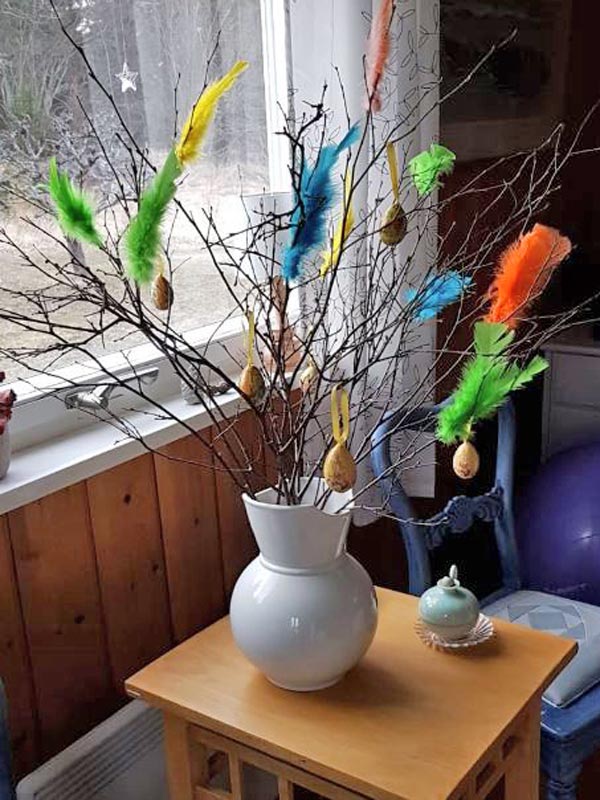
 House's are decorated with “påskris”, ...birch twigs with colored feathers and small decorations. These are placed on dining tables and in windows and are thought to help the spring arrive after the long winter. 

                                                 Easter in the Nordic Countries. Photo: Nature Travels.


 Painting eggs and the Easter egg hunt is also slightly different in Nordic country's 

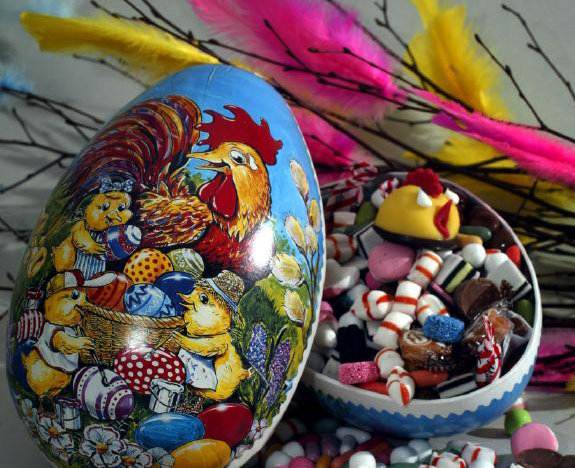
Nordic Easter eggs are not made of chocolate but from cardboard. and hand painted.

They are then filled with sweets and chocolate. these “Påskägg” will be kept by the family and reused for years to come.


                   Nordstjernan


Traditional Easter food,  will be a smörgåsbord in Sweden or roast lamb in Finland and Norway.


Norwegians (Not All) also do a traditional morning sunrise from the mountains 

                                         Introduction to Påske Traditions in Norway | The Nordic Page


Easter witches 

(Swedish: påskkärring, 'easter hag' 'easter witch'

 Finland Swedish: påskhäxa, 'easter witch', Finland Finnish: Trulli, 'Trulli') is an old Swedish legend about witches flying to Blockula (Swedish: Blåkulla, Blå Jungfrun) on brooms on the Thursday before Easter (Maundy Thursday, sv:Skärtorsdagen) or on the night between the Wednesday (Holy Wednesday, sv:Dymmelonsdag) and Thursday before, and returning on Easter.


happy april fools day and i hope everyone has a wonderful Easter.

🧙🧹🥚🐇