Showing posts with label winter. Show all posts

Sunday, January 25, 2026

Winter Cryptids, The Chanoo

 .


                                      🥶❄️💀❄️🥶.                        


Chanoo,  Also called the "Kiwakwa" or "Apotamkin" is a cryptid  similar to the  Wendigo .

The Chenoo legend is from the Wabanaki Algonquin  tribes and according to Folklore it was once  human though just like the wendigo the person was transformed after committing an act  cannibalism or refused to feed the starving.

 This caused the human's heart to freeze and turn to pure ice. Once this happens, the person changes into a Chenoo. 

These fierce creatures are giants compared to normal  humans and described as being both man and beast. 

They look like a haggard, naked old man with  predatory  eyes and may have chunks of flesh missing where it has eaten its own flesh (lips, arm skin and shoulders).
again very similar to a wendigo with the large figure, missing flesh and apatite for human meat.
 It will often cover its flesh in pine resin and roll in leaves and fallen branches to make a camouflage for itself in the forest.

 They live in the far, north and come  down to raid villages when hungry snatching up any unfortunate individuals they can.

Their frozen heart is they key to killing them.
 A special medicine, known only to the tribes, can cause them to vomit up the heart of ice and the hearts of those they devoured and become human again. But generally, saving the human is not possible....

 One way to kill a Chanoo is to  give it a bit of salt. The salt will melt it's icy heart another is to chop it up into several pieces ( though that would also work on most things).

The Chenoo myth probably originated as a means to discourage cannibalism during hard times and harsh winters when food was scarce and not sharing food could mean death and desperation could lead to cannibalism. 

 Another possibility is that the Chenoo may actually be a northern  bigfoot, in fact there are several Indian legends that speak of bigfoot/sasquatch /hairy man ect taking women and children from the camps and eating them.  


Wednesday, January 21, 2026

Winter Cryptids, The Muhaha


The Mahaha or Maha  is a winter creature from Inuit folklore, it has a thin but strong human like figure with ice blue skin that's cold to the touch and  long hair that appears frozen solid.


It's shirtless and barefoot, being unbothered by the cold. It always has a crazed or  unnerving smile  on its face. It also has long, bony fingers with long, sharp fingernails. It's preferred method of attack is Tickling ... It will tickle you to death leaving you frozen  with a twisted smile on your face.(Frozen Grin or Death Smile) it  roams the Arctic searching for victims, usually lone travelers.

Fortunately it's not very intelligent and can be easily tricked, if you ever encounter the Mahaha just ask it to have a drink with you at a stream or river when it  bends down to drink, push it into the water and watch it be swept away by the currents.


Some believe this myth may have originated as an explanation for the  expressions seen on some victims who have frozen to death.( Death Smile).

 It's mostly used as a coutanary  warning  to prevent people from wandering off alone in the harsh arctic especially during winter.


Wednesday, December 31, 2025

Winter Cryptids: The Snow Wasset


                            First post of 2026

🏔️The Snow Wasset ❄️


The Snow Wasset this cryptid is  a legless white fured creature that spends most of its life underground, only coming to the surface to eat.

It became a popular story with lumper jacks during the pioneer days.

This winter weather cryptid can be found mostly in Canada in the forest between the Great Lakes and Hudson Bay.

Though it dose travel for the seasons similar to birds flying south, the Wasset prefers to spend the summers in the far north  where it hibernates  during the warm summer season,  during the winter its fur is white as snow but in the summer its hair turns green and it sometimes curls up in a cranberry marsh or some other cool place to sleep.

It will also grow small legs in the summer to help it slowly move along.

Once the weather starts getting cooler and the first strong snowstorm hits, it sheds its legs and starts moving  south. It travels in the winter like a dolphin in the ocean, dipping in and out of  the snow. It also uses this method to hunt the burrowing grouse, rabbits and other varmine hiding in the snow. Later in the winter, when food becomes scarce and more difficult to obtain, even wolves are on the menu.


 The Wasset has a massive appetite, comparable to an angry wolverine, but  at least four times as big and several times as active.

The only Wasset ever examined by non Indians was a mostly intact one seen by  a group of surveyors in James Bay who happened to encountered an Indian in an odd looking  canoe,  the canoe was said to be made out of a stretched out Wasset hid. There we're no leg holes in the white pelt and it was long enough to make a one man canoe. Sleds are also made from its pelt.


Capturing a Wasset  is tricky, because it's underground and you can never by quit sure which direction it's head is facing. You need a large amount of logs. Then you bait an area and set a tigger. The trigger is set so that a dozen or more  logs fall in from all sides at once  toward the bait, pinning the animal under the snow wherever he may be hiding.

In the 2015 horror themed remake of Fearsome Creatures, the Snow Wasset is a lot more furry and its head is more doglike. 


The Snow Wasset is considered to be the second toughest fearsome creature after the Hodag, but despite its carnivorous diet, the Snow Wasset is not a threat to humans during the summer , but only in the summer time, in the winter its a different story and we are on the menu.


 The Wasset's meat is  edible and "safe " to eat( Not toxic or poison), even when raw. However, the Snow Wasset, is said to regenerate (comeback to life) even if it's just a skeleton so you may have one burrow out from your stomach if eaten.

. Its scientific name is Serpentoformus ferox.


🎇Happy ❄️New❄️Year🎆


Saturday, December 20, 2025

Winter Folklore: Lutins..


Lutin....

❄️🧝‍♂️🧝‍♀️❄️


These small gnome like creatures can be found in  Scandinavia, Germany, England and a few other Locations including  America and Canada.

In Chicago there is a small demon, leprechaun or gnome like being called The Nain seeing him I'd said to be a bad omen followed be something bad happening to the the city.   ( Fire, sickness economic hardship ect ) He is most often described as childlike in hight with red or black fur boots and  "blazing red eyes and rotten teeth 


...........

 The word Lutin is usually translated to English as: brownieelffairygnomegoblinimpjetin ..... pretty much any small figure depending on the region he is spotted in.

 He  can take several different forms  dogs cats other small animals or even a horse with a saddle ready to ride,  in this shape he's called Le Cheval Bayard. Or he could just stay completely invisible.


In  Quebec Canada he's considered a type of  spirit that can take  the form of either pets (usually a dogs or rabbit) or other animals from the region. It's believed that an animal with all white fur could be a Lutin especially a  white cat, though any  animal that lives in or near a home could  be a Lutin in disguise.  


The are essentially House spirits, similar to a Nisse or a Kikimora , they can be either   good or bad, the good ones use their  powers in a verity of ways ranging from  controlling the weather, to shaving the beard of the master of the house before he wakes up  Sundays.


Bad of simply offended ones  may harass the home owner with  minor troubles, like dulling  a  scythe blade or filling someone's shoes with pebbles. 

Good or bad they all seem to absolutely hate salt and will go out of their way to avoid crossing it when spilled on the ground.

 They also occasionally seem to enjoy tangling human or horses' hair into elf-locks.


 ......

It Lapland mythology, they are helpers to Pêre Noêl (Santa🎅) Basically elves.


One of the older Lutin references can be found in the French fairy tale "Le Prince Lutin", written in 1697 by Marie Catherine d'Aulnoyshe    gives a description of their powers........

 "air, water and terrestrial lutin": "You are invisible when you like it; you cross in one moment the vast space of the universe; you rise without having wings; you go through the ground without dying; you penetrate the abysses of the sea without drowning; you enter everywhere, though the windows and the doors are closed; and, when you decide to, you can let yourself be seen in your natural form.

 In this story a red hat with two feathers makes them  invisible to everyone.


Tuesday, January 7, 2025

Winter Yokai : Yukinba


Yukinba - 雪婆 - Snow hag.

Her story is pretty similar to other winter Yokai  stories, except for the fact that some Yokai like the Yuki Onna can show some degree of kindness. The yukinab has no such warmth, she is just bad, she is constantly on the hunt for kids who she then kidnaps and eats.


Her name combines the kanji雪 (yuki; snow) + 婆 (ba; hag). Though it's slightly different depending on the region. In Yamagata prefecture she's called the Yukinbanba (雪ばんば) with “banba” being a regional dialect for “hag.”

The similar child eating yokai, the Yukifuriba, has a nicer name but is equally as horrible . 雪降り(yukifuri; falling snow) + 婆 (ba; hag, old woman) or The Old Woman of the Falling Snow.

The Yukinba looks like an actual monster she is just a  giant head hopping on one leg, with a lot sharp,  teeth and grasping clawed hands. 

The Yukifuriba just looks like a normal old woman with pale, white skin and dressed in a thin, white kimono who always carries a red rope. She may possibly even be an elderly version of the  Yuki Onna. 

Tthe Yukinba Origins..

"Once in the dead of winter, a man was walking through a snowy wheat field when he heard a woman's voice calling out to him. As he looked, a one-legged crone with wild hair appeared and tried to attack him. He fled desperately, when the snow cleared, Yukiba disappeared..."


Both the Yukinba and the Yukifuriba are well known child eaters. They hide out in the mountains and call out to children in an old woman’s voice, preying on the trusting nature of the young. They lure the children in , capture and eat them. 

Parents in the colder region like Niigata prefecture  warn their children not to play at nights when the Yukinba and Yukifuriba are hunting.


Yokai in the mountains and winter seem to have a preference for eating kids, the Yamauba mountain witch in another one to be wearying off.  In many areas, the Yukifuriba is considered to be a “snow version” of the Yamauba in the same way that the yeti is basically  a snow version of bigfoot.


There are many winter yokai described as having only  one foot.

Similar to the  Ippon Datra another Yokai that is mostly peaceful except for December 20th of each year, on that day it will kill any human it comes across.


Most of these are snow monsters, like the Yuki Nyudo and the Yukibo. The legend comes from an uneven patter of snow melting. When snow melts in pockets, it looks like something with a single, large leg has been hopping around the forest. In the case of the Yukibo, this happens in tree wells.  people saw these track like marks and imagined a one-legged snow monster roaming the mountains.


 the Yukiba was also affiliated with "small fuzzy winged insects" called "yuki-mushi" or "snowbugs" - its been believed that if they appear during the autumn, a yukinba  attack occur soon.


Thursday, December 28, 2023

Barbegazi: Frozen Beards


❄️🏔️ Barbegazi 🏔️❄️


The Skiing gnomes of the Alps.

The Barbegazi is type of gnome from Swiss and French folklore, they live deep in the mountainous areas between France and Switzerland; the Alps. 


They make their homes in a large networks of caves and tunnels  near the peaks of mountains through hidden entrances .

They spend most of the year in their underground home, and sleep all summer(like a summer hibernation). Only going out in the winter, because of these habits human interaction is rare.

The name comes from  barbes glacées roughly meaning 'frozen beards'. They get this name because they appear to have icicles growing from their chins instead of a beard, but this is just a result of the freezing temperatures they live in underneath the ice is just a normal beard.

Appearance wise they look similar to a mini yeti, they are covered in white fur like a snowsuit and have large feet, though unlike a yeti this guy's are no larger then an average gnome and nowhere near as violent as a yeti.

 They have been known to help or at least warn skiers and travelers of danger and even aid people.  The most well known form of  warnings they give to humans in possible dangerous areas or circumstances  is the whistling noises they make that sounds similar to a marmots or an eerie hooting noise, that  may be mistaken for gusts of wind, to warn hikers of avalanches. They may also attempt to dig out people trapped by snowfall or herd lost sheep back to their owners. Despite these beneficial activities their attitudes towards humans are still uncertain so if you encounter one do so with caution.

They have disproportionately large bigfoot like feet for their size , they use these oversized feet as snowshoes and ski's to travel across their frozen mountain homes.


They are never encountered in weather above zero degrees or below the tree line on the mountains they live in  they prefer the cold frozen climate the more snow the better.

One of their favorite activities is riding on top of avalanche 

They also have the ability to dig at a rapid pace, they can quickly bury themselves in snow to hide in a matter of seconds as well as dig themselves out of a snow drift no matter how deep .


Last post for the year, have a great New Year

🎇🎆


Wednesday, December 13, 2023

Winter Yokai: Oshiroi babā


❄️Oshiroi babā❄️

The white face powder hag.

This Yokai can be traced back at least as far as 1537.

Oshiroi babā are yokai that take the form of  old woman who appear in snowy mountainous areas near the end of the year. 

Oshiroi Baba (oshiroi; white face powder) +  (baba; old woman, hag). The word oshiroi specifically refers to the white face powder used by geisha and maiko.

She wears a tattered old kimono and a massive, straw umbrella hat covered in heavy snow,she carries a bottle of sake, usually a classic ceramic tokkuri and her face is covered in oshiroi powder, usually slathered on without  care for appearance.

Some claims say you will hear the sound of a mirror dragging and clattering abut from behind her as they hobble through the streets. Though the mirror is almost never actually seen.

 Her back is disfigured, twisted and bent like an old woman’s after a lifetime hard work. 


She carries a cane in one hand, and a sake bottle in the other, and wear a broken straw hat. 


Her most defining feature is their wrinkly old face caked with thick, sloppy, white face powder.

Oshiroi babā don’t tend to interact with humans too often. For the most part, their looks alone are  enough to ward if interactions.

 Though they will occasionally bother people, demanding makeup or trying to buy sake. In this way they are somewhat similar to other old hag yōkai who wander the streets at night, such as amazake babā. However, nearly every account of oshiroi babā describes them as hideous or scary, but not dangerous. 

Other version of the myth claims she appears on cold snowy nights and offer's warm sake to those in need.

According to some local legends, oshiroi babā are a variation of yuki onna. They leave the  mountains and wonder into villages on snowy nights.


 Others say they are more similar to yama uba, who sometimes demand makeup from travelers or can be found  at the bases of mountains trying to buy alcohol.


 According to Toriyama Sekien, oshiroi babā serve as the attendants of Shifun Senjō, the goddess of cosmetics which would explain the mirror, and make up requests.


❄️🍺🪞🧓🏔️


Monday, December 11, 2023

Drakavac


           Drekavac 


It's name means the screamer" or "the screecher,  as it's name would suggest its known for its distinctive and often terrifying scream.


The Drekavac is most often encountered  at night, especially during the twelve days of Christmas (called unbaptized days ) and in early spring, when other demons appear most often. 


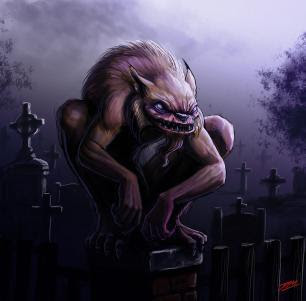
It takes the form of the child, though deformed with elongated limbs and sometimes fur.

In other story's (especially more modern tellings) it usually resembles a dog like creature. However it can also assume other forms as well like a dappled foal, dog, cat, or bird or even a  human like being with glowing eyes. Other visions of the cryptid are described as a dog like beast that walks on its back legs, a long legged long necked animal with a cats head or an undead vampire like man that wonders the cemetery similar to a ghoul.


Originally believed to have come from the soul of a corrupt or sinful man, or from children who died unbaptized 

When seen in it's human form it looks like a child, and  predicts someone's death while in its animal form, it predicts cattle disease.

The Drekavac ether dislikes or fears dogs and is believed to avoid dogs and bright light.

 There is also a common belief that if the shadow of drekavac falls on someone then that person will become sick and eventually die.


In some regions it could be considered a type of boogyman, used to  scare kid's into behaving, in a similar way a the Boogeyman is in other places. 


It's also used as a scare tactic to keep smaller children from wandering to far from home. 

......


Other cryptids or monsters similar to a drakavac..


  • Bukavac – recorded in Syrmia, a six-legged monster with gnarled horns, slimy skin and long tail, that lives in water (rivers, swamps and creeks) and comes out of it during the night. It is known that it makes loud noises, and it will try to strangle people and animals that it encounters;
  • 👹👻🧛‍♀️
  • Jaud (pronounced [jaud]) – a vampirised premature baby.
  • 🧛‍♀️
  • Myling – from Scandinavian folklore, a phantasmal incarnations of the souls of unbaptized children that had been forced to roam the earth.
  • 👻
  • Nav – the soul of dead child that died before its third age.
  • 👻
  • Plakavac – recorded in Herzegovina, is a newborn strangled by its mother, which will rise from its grave at night as small vampire-like creature, return to its house and scream around it, but otherwise can't do any harm.
  • 🧟👻

  • Poroniec – a hostile and malicious demon from Slavic mythology. They were believed to come into existence from stillborn fetuses, but also from improperly buried remains of children who had died during infancy.

👹