Showing posts with label Easter. Show all posts

Saturday, April 4, 2026

Paranormal, Easter Bunny 🐰...Or is it?...


For many people Easter is a joyous occasion, family gatherings, a long weekend and for kids it also means a visit from the Easter bunny. But what if I hat sweet little rabbit is more then he seems?


For most people Easter is celebrated around the world as a religious holiday commemorating the resurrection  of Christ.

But for others especially children it's a time of excitement and anticipation as they await the arrival of the Easter bunny and a basket of goodies . Colorful eggs and chocolate delivered by a kind magical bunny.

 what's not to like about that!

All fun and games, right?

However, for years now there have been sightings of a "Easter Bunny"  that is a lot creepier then common depiction would suggest.


Many have claimed too see a large human or near human sized rabbit, sometimes with intimidating red eyes and sharp teeth not exactly the kind and cuddly bunny we often think of.


Now, many would argue that what is being seen is nothing more then a prankster in a costume or a young child's imagination going a bit overboard. However some of these sightings seem to exhibit supernatural qualities like the  human sized bunny appearing out of nowhere or having ghost like  abilities ranging from  being semi transparent or walking through walls sometimes even disappear at a moments notice.

If these sightings where only a few that would be one thing, but there have been similar accounts around the world. Some believe this is a coincidence or possibly even a form of mass hallucinations. Other believe it to be a type of tulpa.


A tulpa is a creature created by thought alone either by a intense   concentration by an individual or through mass beliefs by a large number of people. Basically if enough people believe in something it is essentially willed into existence ... Though they are hard to control and often dangerous as they will eventually take on a will of their own...


Others claimed this is nothing more then an  urban legend, in any case it's still interesting to think the simple fact that people believe is enough to make it a reality. 


.........

In America, the original Easter Bunny tradition we celebrate today can be traced back to German immigrants who  brought there Folklore and tradition with them, in pagan times the rabbit was a sign of spring and fertility along with the egg. During the christianization of Europe many pagan customs where incorporated to gain more followers. The original Easter Bunny was the Osterhase Easter Rabbit .


The Angelo Saxon Goddess of spring fertility was called Ostara or Eostre her symptoms were the egg and the hare representing fertility. The colored eggs and bunny are still used to this day in our Easter celebration.

And modern pagans still hold a festival for the Goddess Eostre during the spring equinox.


Anyway Hope you all have a good weekend and Happy Easter. 

✝️🐇🥚🐣

Wednesday, April 1, 2026

Paranormal folklore, The Rasselblock


 Mythic horned rabbits.

Most of us have heard of the jackalope, an American cryptid that is basically a hare with antlers.

but this creature or at least one very similar can be found in several other countries,

Today's post will be about the Rasselblock.

but there are several other similar antler bunny's.

The Austrian rauracl, the Hessian dilldapp and the western alpine dahu, the Wolpertinger (winged rabbit with horns) and the  dahu (a mountain goat like cryptid) are also associated with the rasselbock.
.....

The Rasselbock (German: [ˈʁasl̩ˌbɔk]), sometimes called  raspelbock, is a rabbit cryptid from German, Austrian and Bavarian folklore often found in  hunting lodges as a display / hunting trophy. 


It looks just like an average rabbit with the exception of the noticeable horns on top of its head. Its antlers look like those of  a  deer. 

The female rasselbock is called the Rasselgeiß, they have smaller antlers. Some rasselbocks have been shown with small canine teeth, unlike normal rabbits. 


Their young are called Waldrasslinge. 


They have been seen in the Harz Mountains and  near Schwarzatal, the Schmücke, and Auerhahn, a forest town near Stützerbach and Ilmenau. Some even claim to find footprints in the snow, though this could just be a normal bunny in the winter. 

These little guys have also been spotted several times in or near the Thuringian Forest.

This little cryptid was even featured on money at one point and  can be found on the 1921 Blankenhain Notgeld: A banknote from Blankenhain.


.......

Other rabbit cryptids 🐇🐰

The Jackalope..

....

And 

The Wolpertinger


Tuesday, August 26, 2025

Cross in the Sky. ☁️✝️☁️


On Friday April 18th 2025 (Good Friday) people witnessed a cloud shaped like a glowing cross in the night sky over Sydney, Australian.

The cross appeared to be glowing while being lit up by the moonlight breaking through, created a striking and symbolic image that many found moving, especially given the timing that close to Easter. 

However, meteorologists trying to rain on everyone's parade claim it was a nothing more then a natural optical phenomenon caused by light interacting with turbulent weather patterns. Whether you see it as a religious sign or simply a beautiful natural effect doesn't matter, it still looks cool.


Saturday, April 1, 2023

Påskkärringar: The Easter Witch


                                                                       Påskkärringar

                                                               Easter Witches

More than 200 innocent women were tortured to death in Sweden during the witch hunts of the 1600's

Because of rampant fear during this time, doors and dampers were locked to guarded against traveling   witches on there way  to Blåkulla to meet the Devil. Any tools the witches could use on their trip were put away. Barn doors were secured to prevent the witches from milking or riding the animals


The last swedish witch was sentenced in 1704 but it was not until 1779 that the death penalty for witchcraft was repealed. 

Now  it's an Easter tradition for children to dress as witches, old women and old men and go door to door for treats similar to the American  trick-or-treating tradition of Halloween on Maundy Thursday or the day before Easter (Holy Saturday).

The children sometimes present hand-made cards and other greetings. Related to warding off witchcraft and at a similar time of year is the Walpurgis Night celebration. 


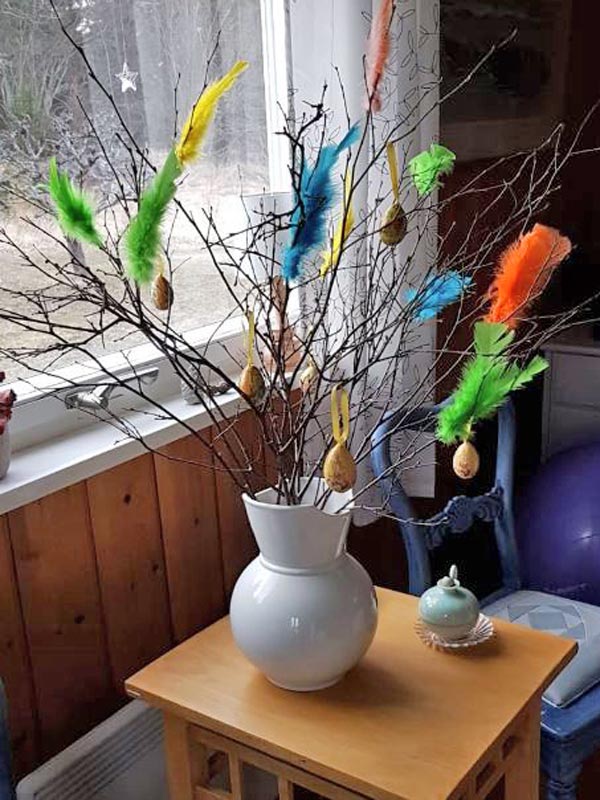
 House's are decorated with “påskris”, ...birch twigs with colored feathers and small decorations. These are placed on dining tables and in windows and are thought to help the spring arrive after the long winter. 

                                                 Easter in the Nordic Countries. Photo: Nature Travels.


 Painting eggs and the Easter egg hunt is also slightly different in Nordic country's 

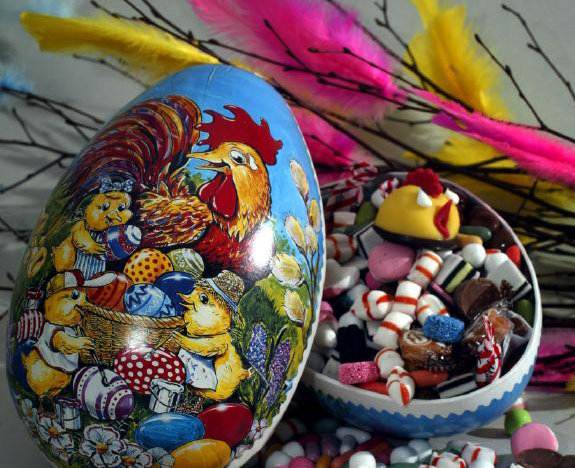
Nordic Easter eggs are not made of chocolate but from cardboard. and hand painted.

They are then filled with sweets and chocolate. these “Påskägg” will be kept by the family and reused for years to come.


                   Nordstjernan


Traditional Easter food,  will be a smörgåsbord in Sweden or roast lamb in Finland and Norway.


Norwegians (Not All) also do a traditional morning sunrise from the mountains 

                                         Introduction to Påske Traditions in Norway | The Nordic Page


Easter witches 

(Swedish: påskkärring, 'easter hag' 'easter witch'

 Finland Swedish: påskhäxa, 'easter witch', Finland Finnish: Trulli, 'Trulli') is an old Swedish legend about witches flying to Blockula (Swedish: Blåkulla, Blå Jungfrun) on brooms on the Thursday before Easter (Maundy Thursday, sv:Skärtorsdagen) or on the night between the Wednesday (Holy Wednesday, sv:Dymmelonsdag) and Thursday before, and returning on Easter.


happy april fools day and i hope everyone has a wonderful Easter.

🧙🧹🥚🐇


Friday, April 2, 2021

Pagan Origins of Easter and The Easter Bunny


         -------------Happy Easter----------------

                          =============================================

                    🐰Hope everyone has a great Good Friday and an awesome Easter!🐰

                 ===================================================


Like many modern Christian holidays, Easter  and the Easter Bunny can be traced back at least in part too older pagan traditions and celebrations .


The festival of Ostara / Ēostr


                                                        Goddess Ostara/ Easter...


In most Europe countries , the name for Easter is derived from the Jewish festival of Passover.

In Greek the feast is called Pascha, in Italian Pasqua, in Danish it is Paaske, and in French it is Paques,"

But in English-speaking countries, and in Germany, Easter takes its name from a pagan goddess from Anglo-Saxon England who was described in a book by the eighth-century English monk Bede.

Ostara otherwise known as Ēostre, is the Germanic  goddess of spring and dawn and fertility. 


On the old Germanic calendar, the equivalent month to April was called “Ōstarmānod” – or Easter-month.

Ēostre is attested solely by Bede  in his 8th-century work The Reckoning of Time, where Bede states that during Ēosturmōnaþ (the equivalent of April), the pagan feasts in Ēostre's honor, but that this tradition had died out by his time, replaced by the Christian Paschal Month  a celebration of the resurrection of Jesus.

 Historic linguists  have also traced the name to a Proto-Indo-European goddess of the dawn   Ausṓs from which descends the Common Germanic divinity from whom Ēostre and Ostara are held to descend.


 Scholars have also  linked the goddess's name to a variety of Germanic personal names, a series of location names in England, and, discovered in 1958, over 150 inscriptions from the 2nd century CE referring to the matrona Austriahenae.


There are several theory's that connect Ēostre with records of Germanic Easter customs  that alsoincl hares and Egg's. Particularly prior to the discovery of the matronae Austriahenae and further developments in Indo European studies, there have been several debates  among some scholars about whether or not the goddess was an invention of Bede. Ēostre and Ostara are sometimes referenced in modern popular culture and are venerated in some forms of Germanic neopaganism.

  ==============

During pre-christian times, people have celebrated the equinoxes and the solstices as sacred times

The spring equinox is a day where the amount of dark and the amount of daylight is exactly identical, so you can tell that you're emerging from winter because the daylight and the dark have come back into balance. The cycle of birth, death and rebirth...."People would plan out their whole life according to the patterns of nature.

Once Christianity took root across Euroup, the Easter period became associated with the resurrection of Christ.

In the first couple of centuries after Jesus's life, feast days in the new Christian church were attached to old pagan festivals,

Spring festivals  were to celebrate the end of winter and the retrn of warmer seasons, the main theme was new life and relief from the cold of winter this later became connected to the resurrected of Christ after the crucifixion.

 In 325AD the first major church council, the Council of Nicaea, determined that Easter should fall on the Sunday following the first full moon after the spring equinox.

This is why the date moves and why Easter celebrations are sometimes referred to as "moveable feasts".

There's a defined period between March 25 and April 25 on which Easter Sunday must fall, and that's determined by the movement of the planets and the Sun.

===================

 Easter eggs and the Easter Bunny 

======================

Ostre is a goddess of fertility her main  animal symbols are bunny and eggs. 

Rabbits are  known for their high rate breeding as such they have traditionally symbolized fertility, and eggs represent new life.


It’s believed that decorating eggs for Easter dates back to at least  the 13th century. 

 People began decorating eggs and eating them as a treat following mass on Easter Sunday after fasting through Lent.this is still something that happens in modern times, especially in eastern European countries like Poland.

During the 19th century Russian high society also started exchanging ornately decorated eggs—even jewel encrusted one's on Easter.


 ========================================

                   -----The Easter Bunny-----

 
According to some sources, the Easter bunny first arrived in America with German immigrants who settled in Pennsylvania..
 

The first association of the rabbit with Easter was a mention in  the "Easter hare"  a book by a German professor of medicine Georg Franck von Franckenau published in 1682.

He recalled a folk story that hares would hide the colored eggs that children hunted for, which would indicate that at least as early as the 17th century, decorated eggs were hidden in gardens for egg hunts.

==============

Von Franckenau taught anatomy, chemistry and botany in Jena and became a professor of medicine at the University of Heidelberg.

  In his "On Easter Eggs" essay, which he published around 1682, he considers ancientpagan symbols of life and fertility connected with religious traditions. 

 On the Easter bunny, he says this ---in Alsace, and neighboring regions, these eggs are called rabbit eggs because of the myth told to fool simple people and children that the Easter Bunny is going around laying eggs and hiding them in the herb gardens. 

So the children look for them, even more enthusiastically, to the delight of smiling adults. 

-----------

These legends were preserved and improved upon by the Pennsylvania Dutch, who referred to the Bunny as the Oschter Haws. 

Beginning in the1680s, children around Germantown Pennsylvania would build nests out of hatsand bonnets, place them in the yard, or out by the barn and, on Easter morning, they would be found filled with colorful eggs. 

The decorated hats and bonnets eventually evolved into Easter baskets.

These custom's later spread across the U.S. and the bunny’s Easter morning deliveries would later  include chocolate and other types of candy and gifts, while decorated baskets replaced nests, children often leave out carrots for the bunny in case he gets  hungry from all his hopping.

 '''''''''''''''''''''''''''''''''''''''

The Easter Bunny  or  Easter Rabbit 

This magic mythic bunny is believed to have  originated  among German Lutherans, the "Easter Hare" originally played the role of a judge(similar to Santa and his list), he would  determine  whether or not child's behavior  had been good or bad in at the start of the season of Eastertide. 

The Easter Bunny is sometimes depicted with clothes. In legend, he carries colored eggs, candy, and sometimes even toys in his basket  to the homes of children, another  similarity he shares   Santa Claus, they both bring gifts to children on the night before their respective holidays.


                                                 ----------------------------------------

Bunnies aren’t the only animal traditionally associated with Easter in every country. Some identify the holiday with other types of animals like foxes and even the  cuckoo birds.

whatever you believe in bunny fox or bird i hop you all have a great Easter weekend.


                      :) Happy Easter :)


Thursday, August 29, 2019

History of Easter and it's Pagan roots..

                                 
                                                    A odd time of the year for this post lol but here ya go......

 Ostara,  is the Goddess of spring time and  Fertility her symbolizes are egg's and Hares, representing birth fertility and new life.
 Ostara otherwise known as Ēostre, is the Germanic  goddess of spring and dawn and fertility. On the old Germanic calendar, the equivalent month to April was called “Ōstarmānod” – or Easter-month.

Ēostre is attested solely by Bede  in his 8th-century work The Reckoning of Time, where Bede states that during Ēosturmōnaþ (the equivalent of April), the pagan feasts in Ēostre's honor was heald, but that this tradition had died out by his time, replaced by the Christian Paschal Month  a celebration of the resurrection of Jesus.

 Historic linguists  have traced the name to a Proto-Indo-European goddess of the dawn   Ausṓs , likely the original  goddess the Germanic  Ēostre and Ostara are based on. Additionally, scholars have linked the goddess's name to a variety of Germanic personal names, a series of location names in England, and, discovered in 1958, over 150 inscriptions from the 2nd century CE referring to the matrona Austriahenae.


Theories connecting Ēostre with records of Germanic Easter customs  including hares and Egg's, have been proposed. Particularly prior to the discovery of the matronae Austriahenae and further developments in Indo European studies, there have been several debates  among some scholars about whether or not the goddess was an invention of Bede. Ēostre and Ostara are sometimes referenced in modern popular culture and are venerated in some forms of Germanic neopaganism


Did you know roughly 61 million eggs will be dyed  in the US each year, ? 


Did you ever wonder why the egg is symbol of Easter?or wonder why they are brightly colored? And where did this magic rabbit come from anyway?

Eggs are an ancient symbol of new life and springtime.
Eggs have become a sort of metaphor for Jesus rebirth, but originated as a Pagan symbol of spring and fertility.  Later incorporated into the christian church lake many other pagan traditions.


The early Zoroastrians used eggs as a symbol of the Vernal Equinox." FYI, Easter is celebrated on the first Sunday following the first Full Moon after the equinox. Of course, most of the people painting eggs this year don't identify themselves as Zoroastrians, the church has incorporated many old tridiagonal rituals and costumes to convert new followers (as apposed to  torture or burning them at the stake, that doesn't leave many new patrons..) 


 Easter eggs came to the United States with the German settlers in the early 18th century. They brought us a lot of the Christmas and Easter traditions we have today. They also brought us the easter bunny. 

The tradition of decorating Easter eggs isn't a modern development, people have been decorating them in central Europe since at least the 13th Century. That's where the tradition of ornately decorated eggs, à la Fabergé, came from.


So, in case you were wondering whether the Easter egg was invented for purely commercial purposes, the answer is no. It was hijacked for purely commercial purposes (I'm kidding, sort of). The week leading up to Easter does just happen to be the biggest week of the year in terms of egg sales. Though i'm guessing the Easter Bunny is behind that.