Showing posts with label Scandinavia. Show all posts

Friday, February 14, 2025

skogsrå, the Foxy forest nymph


The northern forest's of Scandinavia are cold and dark, they are also home to many mysterious creatures Gnomes, Trolls, Giants, elves ect.


But there's another creatures that haunts these wood, as deadly as she is beautiful...

The skogsrå.

The skogsrå is a swedish version of the huldra.


,............

She most often  appears as a beautiful young woman with  a friendly attitude. 


From the front she looks like a normal woman but  from behind she usually has ether a fox or cow tail sicking out of her skirt/dress and a hollow back (but not always).


More often than not, the men that follow her into the forest are never seen again.

 In some folktales any man  that had sex with her and returned would be like a hollow shell of his former self as his soul remained with her.

 However if the  man is a hunter or someone that was kind to her, he may be rewarded with good luck in the hunt or fishing trip but should he ever be unfaithful to her, he will be struck with extreme bad luck and  accidents. In some cases the bad luck may end if the hunter fires a shot into the woods.

 Nyland, Finland Folklore says firing  silver bullets  can kill a skogsrå


In Norway, the word huldrefolk or huldre (plural)  comes from Old Norse huldr meaning ‘hidden’ it's used for all kinds of supernatural creatures. Hulder, or Huldra in the singular, signifies a female forest spirit, though she may also appear in mountains.


 These forest spirits act alone, instead of in.large group's or families like other supernatural beings, like the vittra. In northern Sweden, the name vittra refers to a group of supernatural beings that lives underground that have many traits in common with fairies from folklore of the British Isles, as well as with the ellefolk in Danish tradition or the huldrefolk /Hilda folk in Norwegian tradition.     


 Finland also has a version of the Huldra/ skogsrå, Some names in the Finnish language, mainly from the west coast, also show a link to the Swedish traditions, metsänpiika ‘forest girl’ or metsänneito ‘forest maid’ are the most often used names for the female forest spirit. However, there are also other localised names such as haapaneitsyt ‘aspen-maid’ or sinipiika ‘blue maid’.          


Her other Swedish names are  skogsrå, skogsrådan, skogsråa ‘forest ruler’, råan, rådande ‘the ruler,/the ruling spirit’, skogsjungfru ‘forest maiden’, skogsfru, skogssnuva ‘forest woman’, skogskäringen ‘the forest hag’, or with a nickname such as Grankotte–Maja ‘Spruce cone-Maja’, Talle-Maja ‘Pine tree-Maja’. She is also known by many different local variants like.. Gonna, Besta, Rånda, Skogela, Lanna-frökna ‘The lady of Lanna’ or Ysäters-Kajsa ‘Kajsa of Ysäter’. On the island of Gotland, there are records of a female troll called Torspjäska that plays the same role and has the same function as forest spirit on the mainland.      Germany has a legend of a long-haired beautiful fores spirits too,.  Called  Holzfräulein ‘the tree lady’, who was dressed in leaves, or as Moosweiblein ‘the moss woman’. 


If you're heading into the woods soon, be weary of any beautiful strangers that may approach you ...... 


 🖤💕Also Happy Valentines Day.💕🖤


Tuesday, December 24, 2024

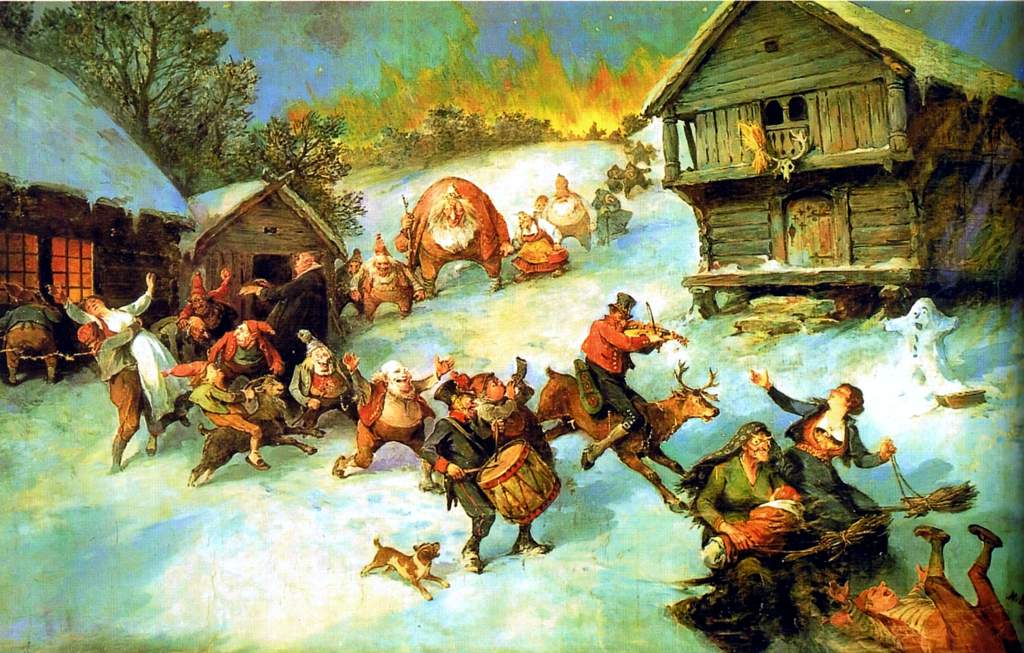
Christmas Elves....


🎄 Christmas Elves ⛄


We all know of Santa and his workshop of elves, but we're did this story come from what are the  origins of the jolly fat man's helpers?


 The modern elf folklore come  from Norse/Scandinavian mythology, the Nisse or house gnome and the  álfar, also called  huldufólk or  hildafolk 'hidden folk'.

Sweden's gift giver before Santa was the Tomten and the Yule Goat though by 1891, the Good old St Nick had merged with Tomten, who was originally an elf or gnome like farm guardian  (like the Nisse).  following the work of Jenny Nyström, this new combination of  old and new Christmas figures became  the Jultomten.


In Nordic countries, Nisse are the closest thing you could consider as Christmas Elves even though  nisse are not actually  elves and they will usually  only wear red instead of the green and red outfits that elves are known for in most western  countries.


 Several  Norse legend were likely combined with other Scandinavian and Celtic legends and myths about these small magic beings.

All kinds of stories about elves, fairies  nature spirits and even gnomes can be found from  multiple regions through Europe there are also similar supernatural beings that could be connected to elves, such as kobolds or duende  from Germany Mexico and South America or the Scottish house spirits called brownies. In Medieval Europe, elves were seen as tricksters and were often linked to demons especially after the christianization of Europe most things of a supernatural or otherworldly nature where considered evil.


The modern  Christmas elf + working in Santa's workshop) appeared in literature as early as 1850 when Louisa May Alcott (Little Women ) completed, but never published a book called Christmas Elves. 


Though a earlier reference to Christmas elf's can be found  In the 1823 poem A Visit from St. Nicholas (   'Twas the Night Before Christmas), by  Clement Clarke Moore, Santa Claus himself is described in line 45: "He was chubby and plump, a right jolly old elf".


The image of the elves in the workshop was also popularized by Godey's Lady's Book, with a front cover illustration for its 1873 Christmas issue showing Santa surrounded by toys and elves with the caption "Here we have an idea of the preparations that are made to supply the young folks with toys at Christmas time".


 During this time, Godey's was a very influential figure to the birth of some of our Christmas traditions, having shown the first widely circulated picture of a modern Christmas tree on the front cover of its 1850 Christmas issue. Additional recognition was also given in Austin Thompson's 1876 work "The House of Santa Claus, a Christmas Fairy Show (Christmas play) for Sunday Schools"

A few other versions of elf's or helpers are

Ded Moroz (father Frost / Grandfather Frost )  and his grand daughter Snegurochka (Frost Maiden) from Russia ⛄🎁


Knecht Ruprecht from Germany.🍻🎅

The  Hoesecker in  Luxembourg.🦌

Zwarte Piet (Black Peter) In the Netherlands and Belgium who accompany Saint Nicholas on his global gift giving.🎄

And lastly the modern Christmas tradition involving that ever watchful snitch The Elf on the Shelf  .🧝‍♂️👀


Hopefully none of you are on the naughty list, this year 🙂

Have a great Christmas and happy New Year.

🎄🎁🎅⛄🦌🎄


🦇M🦇

Last Post for the year, thanks for stopping by and have an awesome 2025🎆🎇


Wednesday, October 30, 2024

Scandinavian Folklore: Mara.👻


The Mara is a female spirit like being from Scandinavian mythology.


One of the earliest mention and possibly the original origins of the tale comes from the Norse Ynglinga saga, a 13th century saga written by Snorri Sturlson, an Icelandic poet. 

In the saga King Vanlandi Sveigoisson of Uppsala is killed by a mara which is conjured by the Finnish sorceress Huld, hired by the king’s abandoned wife.

.....


–Ynglinga Saga, Verse 16..


“Driva bribed the witch-

wife Huld, either that she should bewitch Vanlande to return to

Finland, or kill him. When this witch-work was going on Vanlande

was at Upsal, and a great desire came over him to go to Finland;

but his friends and counsellors advised him against it, and said

the witchcraft of the Finn people showed itself in this desire of

his to go there. He then became very drowsy, and laid himself

down to sleep; but when he had slept but a little while he cried

out, saying that the Mara was treading upon him. His men

hastened to him to help him; but when they took hold of his head

she trod on his legs, and when they laid hold of his legs she

pressed upon his head; and it was his death. The Swedes took his

body and burnt it at a river called Skytaa, where a standing

stone was raised over him.”
....         
....... .


........
In Polish folklore the mara is described as a soul of a living person who leaves their body at night (astral projection) and are seen by others in the form of wisps of hair or moths. 

In Czech lore there are stories  of a “night-butterfly,” also thought to be linked to the mara legend. 

In Russian folklore she's  invisible but with the ability to also take the form of a woman with long hair. Other mentions of mara in Slavic folklore include descriptions of the her as a succubus-like creature that invades men’s dreams and lead them to their doom (Croatia) and as a spirit who enters through the keyhole and strangles you while you sleep (Serbia). 

In Turkey, the mara is called the Karabasan which translates to “ominous-presser.”

,.....


In the  Icelandic Vatnsdæla saga as a spirit connected to the fate of the person it is attached to and in the Eyrbyggja saga (also Icelandic in origin) where the sorceress Geirrid is said to assume the shape of a marlíðendr or “night-rider.”


In Germany there are records of charms and prayers to ward off the mara, such as the below:

Here I am lying down to sleep;

No night-mare shall plague me

until they have swum through all the waters

that flow upon the earth,

and counted all stars

that appear in the skies.

Thus help me God Father, Son, and Holy Ghost. Amen!..

,..... . 


The legend of the mara is also connected to the legend of the old had or night hag, a story used in many cultures to explain sleep paralysis. 

The first definition of sleep paralysis appears in Samuel Johnson’s Dictionary under the term “nightmare”:

Nightmare n.s. [night, and according to Temple, mara, a spirit that in the heathen mythology, was related to torment to suffocate sleepers.] A morbid oppression in the night, resembling the pressure of weight upon the chest.


                        Old Hag, Night Hag.

.....


......

Other versions from around the world.
.. 

In Japan it is referred to as kanashibari, which translates as “to bind” or “to tie.”
In Mongolia sleep paralysis is called khar darakh, which translates to “to be pressed by the Black.” 


Thai belief describes sleep paralysis as being caused by a ghost called Phi Am.

Newfoundland and parts of the southern United States where the hag leaves her body and sits on the chest of the victim.

In Arab cultures it is referred to as Ja-thoom which means “what sits heavily on something.” It is believed sleep paralysis can be prevented by reading the Throne verse of the Quran.
......

The origins of the name comes from the Nordic word for nightmare (the Norwegian word for nightmare is mareitt, the Icelandic name is martroo, and the Swedish word  is mardrom). Mareitt and martroo roughly translate as “mare-ride”, referencing the original use of the term, while mardrom translates as “mare-dream.” 


...

🎃 Happy Halloween  👻


Thursday, December 21, 2023

The Yule Lads, Iceland's 13 Santa's.

  ❄️❄️❄️❄️❄️❄️❄️🎄❄️❄️❄️❄️❄️❄️❄️   


Iceland does not have a Santa Clause instead they have Christmas troll's .


The 13 Yule Lads  take turns to visit kids on the 13 nights leading up to Christmas. 


Instead of a Christmas stocking hung by the fire place children in Iceland keep one of their shoes on the windowsill where the Yule Lad will either leave candy or old  potatoes  depending on whether the kids have been good or bad.


The Yule Lads were originally either some what violent or just normal  pranksters depending on the region or who was telling the story. 

Iceland outlawed frightening children's stories in the 1700s after that the Yule Lads took on a more Santa like roll and are now a type of Christmas Troll's.


 They all have special name, that describes their favorite kind of mischievous behavior. 


Their names are:


Stekkjastaur- Sheep-Cote Clod


Giljagaur - Gully Gawk


Stúfur - Stubby


Þvörusleikir - Spoon Licker


Pottaskefill - Pot Scraper


Askasleikir - Bowl Licker


Hurðaskellir - Door Slammer (he loves waking people up by slamming doors)


Skyrgámur - Skyr Gobbler


Bjúgnakrækir - Sausage Swiper


Gluggagægir - Window Peeper


Gáttaþefur - Doorway Sniffer


Ketkrókur - Meat Hook


Kertasníkir - Candle Beggar


They are the children of  Grýla and Leppalúði


Two trolls you don't want to meet, especially Grýla.  You should also try to avoid their family pet the Yule Cat as it has been known to eat people.. Grýla is also well known for kidnapping and eating kids.


The Yule Lads live I northern Iceland in Myvatn at Dimmuborgir in an natural volcanic cave. They spend most of the summer sleeping there and seldom ever leave until winter.

The name of the cave translates to Dark Cities or Dark Fortress.


It seems at one point in the far past there were around 70 children of Grýla but these 13 are all that's left, or at least the ones most remembered.


Hope you've been good this year, you Really don't want Grýla showing up 👹


Have a great Christmas and New Year

🎄⛄


Friday, December 1, 2023

Norse God of Winter🌨️❄️


             ❄️Ullr❄️


Ullr, the Viking God of Winter 


He is the son of the grain goddess Sif, and the stepson of the thunder god Thor.


In chapter 31 of Gylfaginning in the Prose Edda, written in the 13th century by Snorri Sturluson, Ullr is referred to as a son of Sif (with a father unrecorded in surviving sources. 

He's a highly skilled  archer, hunter, skater, and skier.


Ullr - pronounced “ULL-er,” often Anglicized as “Ull,” and sometimes “Ullinn”)


In Grímnismál, it says his home is called Ýdalir, “Yew Dales.”


 He lives at his hall Ydalir, which translates to Yew Dales: yew wood was the material of choice for making bows in ancient Scandinavia. 


Ullr was also known as the god of oaths and combat. It's said that all oaths were taken on Ullr’s ring, which would shrink down to sever your finger should you break your oath.


In some versions of the myths his wife is the giantess Skadi....(in other stories, skadi is the wife of Njord The Sae God.)


 He was the ruler of Asgard when Odin was away for ten years.


There are several locations in Scandinavia  named after him. 


A few of the city's ...

Ullevål,

 Ullevi, 

Ullared, 

Ullensaker 

And Ullensvang..


Because of his status as a winter god, many worshippers would pray to Ullr before travel in the harsh northern winter.


Within the winter skiing community of Europe, Ullr is considered the Guardian Patron Saint of Skiers (German Schutzpatron der Skifahrer).

 An Ullr medallion or ski medal depicting the god on skis holding a bow and arrow, is widely worn as a talisman by both recreational and professional skiers as well as ski patrols in Europe and elsewhere.


Ever since 1963 the town of Breckenridge, Colorado has held a week-long "Ullr Fest" each January, featuring events designed to win his favor in an effort to bring snow to the historic ski town.


Ullr is also a playable character in the video game Smite.


.......


Can't believe its already December, time flys I guess, bundle up and enjoy the snow .

❄️☃️🎿⛷️


Tuesday, December 13, 2022

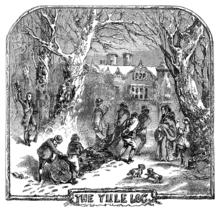
The Yule Log 🎄


                                           Magic Yule Logs Rainbow Flames (Bundle of 3) - TOPS Malibu

                       🎄The Yule Log🔥


Norway is the birthplace of the Yule log. 

  The ancient Norse used the Yule log in their celebration of the return of the sun at winter solstice. “Yule” came from the Norse word hweol, meaning wheel. 

The Norse believed that the sun was a great wheel of fire that rolled towards and then away from the earth.


The Yule log was a long oak tree carved with runes (early norse/germanic letters) to wish for the protection of the gods and burned for the duration of the celebration. To let it go out was said to be a dark omen and a sign of bad luck to come.  

The Vikings would save a piece of the log for next year's fire.


The UK Tradition.


The Yule log, Yule clog, or Christmas block is a specially selected log burnt on a hearth as a winter tradition in regions of Europe, particularly the United Kingdom, and subsequently North America. 

The origin of the folk custom is unclear. Like other traditions associated with Yule (such as the Yule boar.


 The Christmas practice calls for burning a portion of the log each evening until Twelfth Night (January 6th. 


The log is subsequently placed beneath the bed for luck, and particularly for protection from the household threats of lightning and, with some irony, fire. Many have beliefs based on the yule log as it burns, and by counting the sparks and such, they seek to discern their fortunes for the new year and beyond


 the Yule log, Yule goat, and Yule boar (Sonargöltr) are still reflected in the Christmas ham, Yule singing, and others, which Simek takes as "indicat[ing] the significance of the feast in pre-Christian times.


Friday, December 11, 2020

Norwegian Myth and Legends St. Lucia Day, and Christmas

Merry (early ) Christmas everyone. 

OR God Jul, if your from Scandinavia :) 

----------------------------------------------

 With December 13th approaching, i decided to do a post about St. Lucia Day. Those of you with Scandinavian ancestors, or anyone that has been in Norway or Sweden during the Christmas seasons will have heard of Lucci at least once. 


The legend of St. Lucia comes from a combination of old Norwegian myth's and folklore, mixed with the christinization of the old viking world. 


The modern Christian holiday, St. Lucia's day is celebrated with a candlelight procession through the streets with one kid in the group placing a wreath with lit candles on their head and then walking through the school or church in prayer Because of the old practice of staying indoors with all the candles lit and a fire in the hearth to ward of the evil spirits, the church's official St. Lucia's day is also associated with candles and light, and during this night you will see candles in the windows of homes and even along the sidewalks throughout the city.


 ========================= NORWAY ================= 


 Norwegians considered what they called Lussinatten (December 13th) the longest night of the year and no work was to be done. 

From that night until Christmas, spirits, gnomes and trolls roamed the earth. Lussi, a feared and powerful witch or possibly a demoness, would punish anyone who dared work.

 Legend also states  that farm animals talked to each other on Lussinatten, and that they were given additional feed on this longest night of the year. 


The Lussinatt, the night of December 13th, was largely forgotten in Norway at the beginning of the 20th century, though still remembered as an ominous night, and also celebrated in some areas, especially in Mid, Central and Eastern inland.


 It wasn't until after World War II that the modern celebration of Lucia in Norway became adopted on a much larger scale.  It is now observed all over the country.

Like the Swedish tradition, and unlike the Danish, Lucy is largely a secular event in Norway, and is observed in kindergartens and schools  (often through secondary level). However, it has in recent years also been incorporated in the Advent liturgy in the Church of Norway. 


The boys are often incorporated in the procession, staging as magi with tall hats and star-staffs.
Occasionally, anthems of Saint Stephen are taken in on behalf of the boys.

For the traditional observance of the day, school children form processions through the hallways of the school building carrying candles, and hand out lussekatt buns. While rarely observed at home, parents often take time off work to watch these school processions in the morning, and if their child should be chosen to be Lucia, it is considered a great honor. Later on in the day, the procession usually visits local
retirement homes, hospitals, and nursing homes.

The traditional Norwegian version of the Neapolitan song is, just like the Danish, not especially Christian in nature, the only Christian  concept being "Sankta Lucia". Excerpt: "Svart senker natten seg / i stall og stue. / Solen har gått sin vei / skyggene truer."


 ("Darkly the night descends / in stable and cottage. / The sun has gone away / the shadows loom."


You will also see Lucia crown cakes and Lucia buns this time of the year :)

 ...Crown cake...


 ....Buns...


 The English word “Yule”   originated from one or more of seven spellings in Old English, which meant the months of December or January. 


Around the year 900, “Yule” came to mean Christmas and its festivities. Further back, these words came from the Old Norse jól, which in addition to being the root of the modern Norwegian word “jul,” is the root of the word “joli” in French, meaning lovely, nice, or pleasing, and from it the word “jolly” in English.

===========

We all know of Santa and his reindeer, but how many of you know about the Julebukk (“Christmas Goat”) of Norway, known as Julebock in  Swedish, Juleged in Danish, and Olkipukki in Finnish.

Originally the Julebukk was a goat that was slaughtered at Christmastime to celebrate
the end of the agricultural work year.

However over time, it meant a person who led a costumed procession from house to house, to entertain
the residents and be rewarded with food and drinks.

In the early 19th century, the Julebukk also became the bringer of presents,
and was the predecessor of the Julenisse, equivalent to Santa Claus in English.
 
Jul Goat..and St. Nicholas


-------------------


Today the Julenisse and Santa Claus have taken over present-bringing,
but effigies of the Julebukk can still be found all over norway and sweden, most of them are made of straw,  and the largest one is  a giant statue in Gefle, Sweden.

Giant Jul Goat.


Also if your ever in the area you could check out the city of Rovaniemi at the Arctic Circle in Finland.
 

It's About six miles north of the city you will find Santa Claus Village and theme park, located just two short miles from the Rovaniemi Airport.
==


 =================================
Christian version of st lucia.
=================================


St. Lucy was a young Christian martyr who died in the early 4th century in Italy.
She quickly gained a widespread following and is the patron saint of virgins.


Saint Lucy's Day, also called the Feast of Saint Lucy, is a Christian feast day observed on 13 December.
The observance commemorates Lucia of Syracuse, an early-4th-century virgin martyr under the Diocletianic Persecution, who according to legend brought food and aid to Christians hiding in the Roman catacombs, wearing a candle lit wreath on her  head to light her way and leave her hands free to carry as much food as possible.

Her feast day, which coincided with the shortest day of the year prior to calendar reforms, is widely celebrated as a festival of light.

Falling within the Advent season, Saint Lucy's Day is viewed as a precursor of Christmastide, pointing to the arrival of the Light of Christ in the calendar on Christmas Day.

Saint Lucy's Day is celebrated most widely in Scandinavia and in Italy, with each emphasizing a different aspect of her story.
 

 In Scandinavia, where Lucy is called Santa Lucia in Norwegian and Danish and Sankta Lucia in Swedish, she is represented as a lady in a  white dress symbolizing a baptismal robe and a red sash symbolizing the blood of her martyrdom, with a crown or wreath of candles on her head.


 In Norway, Sweden and Swedish-speaking regions of Finland, as songs are sung, girls dressed as Saint Lucy carry cookies and saffron buns in  procession, which symbolizes bringing the Light of Christ into the world's darkness.

In both Protestant and Catholic churches, boys participate in the procession as well, playing different roles associated with Christmastide,  such as that of Saint Stephen. 

The celebration of Saint Lucy's Day is said to help one live the winter days with enough light.


 American Girl Kirsten St. Lucia Wreath and 16 similar items

 A special devotion to Saint Lucy is practiced in the Italian regions of Lombardy, Emilia-Romagna, Veneto, Friuli Venezia Giulia, Trentino-Alto  Adige, in the north of the country, and Sicily, in the south, as well as in the Croatian coastal region of Dalmatia. 


In Hungary and Croatia, a popular tradition on Saint Lucy's Day involves planting wheat grains that grow to be several centimeters tall by Christmas Day, representing  the Nativity of Jesus.


--------------------------------------------------
============================================
Now onto a darker myth.......

 Lussi the witch/ demon.

 Lussi « witchlike

 =======

=========


 Norwegian superstitions: Åsgårdsreia, Lussinatt (night of Lussi), and  Fjøsnissen #OWC #AroundtheCampfire | Pagans & Witches Amino

Nils Bergslien, Julereia, 1922: Lussi is shown stealing a child while riding her broom

================

Tis the season to be jolly, unless you enconter one of the most feared jul tide monsters,
and i'm not talking about Krampus... though a goat hooved, horned anti santa is not an ideal
Christmas guest ether lol.

 8 European Christmas Creatures That Will Give You Nightmares


=======

In the old days people believed that ghost both good and bad along with demons and monsters walked the earth and could interact with us  just the same as the living do. 


Winter was an especially feared time of the year, dark cold and bitter whether, shorter days and monsters to contend with, not exactly  a merry Christmas.


Winters in midevil Norway were dark and cold, and the myths and legends from the region are equally so.
 

Just like the Germanic Wild Hunt, Lussi and her demon hordes would haunt the night, taking anyone they encountered during one of their nightly raids.
 

Starting December 13, in some versions this would go one all the way up until Jul/Yul.
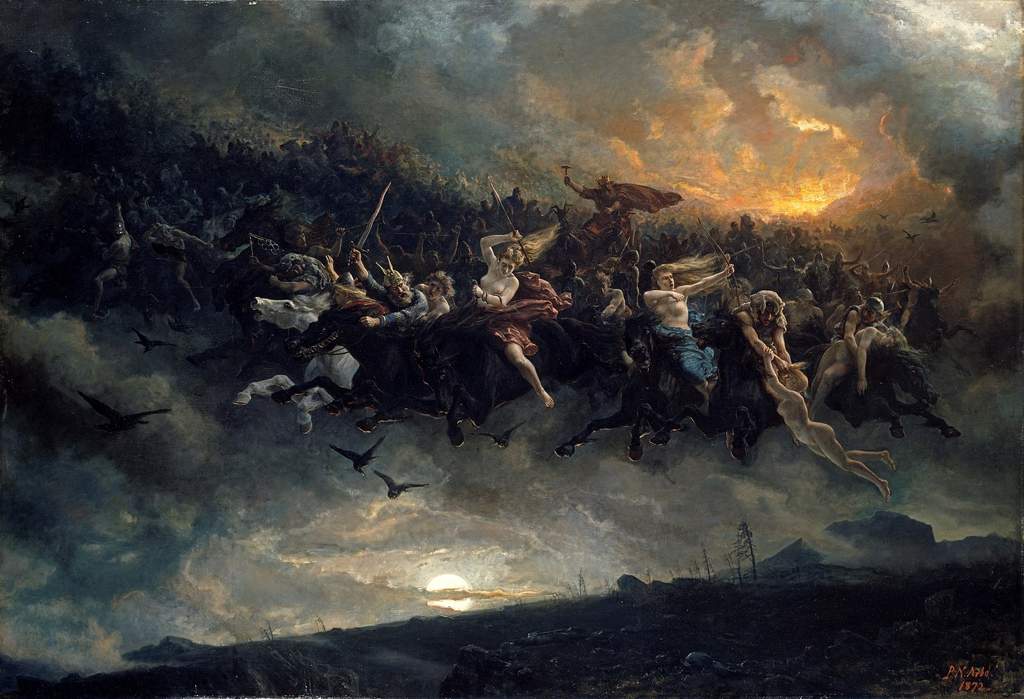
 

 Norwegian superstitions: Åsgårdsreia, Lussinatt (night of Lussi), and  Fjøsnissen #OWC #AroundtheCampfire | Pagans & Witches Amino

The Wild Hunt. 


In the old Julian calendar the longest night of the year was December 13th.

Lussis night.

Lussi, Lussinatta, or just the Lussi Night, was marked on   December 13. when it was believed that  Lussi, a demoness or possibly  a powerful witch would ride through the cold winter night  with her minions, her and her followers,  called Lussiferda, Preying on  anyone foolish enough to be outside after the sun goes down, or anyone who had not finished their preparations for Jul.
 
Lussi was  also seen as a sort of anti-Santa, coming down the chimney to take away bad children. similar to Krampus a Germanic anti Santa that accompanied St. Nicholas and punished bad children.

Krampus - Wikipedia 


 Older triditions

This itself might be an echo of the myth of the Wild Hunt, called Oskoreia in Scandinavia, found across Northern, Western and Central Europe.

Between Lussi Night and The cow, trolls and evil spirits, and in some accounts even the spirits of the dead,  thought to be active outside.
It was believed to be particularly dangerous to be out during Lussi Night.

According to tradition, children who had done mischief had to take special care, since Lussi could come down through the chimney and take them away,
and certain tasks of work in the preparation for Yule had to be finished, or else the Lussi would come to punish the household.
The tradition of Lussevaka – to stay awake through the Lussinatt to guard oneself and the household against evil, has found a modern form through
throwing parties until daybreak. Another company of spirits was said to come riding through the night around Yule itself, journeying through the air,
over land and water.

There is little evidence that the legend itself derives from the folklore of northern Europe, but the similarities in the names ("Lussi" and "Lucia"),  and the date of her festival, December 13th, suggest that two separate traditions may have been brought together in the modern-day celebrations in  Scandinavia. Saint Lucy is often depicted in art with a palm as the symbol of martyrdom.,

==============


The best way to avoid meeting  monster Lussi was to stay up all night long, indoors with all the lights on.


In short, if you don't want to meet Lussi just say inside with a warm fireplace and a lot of light maybe some hot chocolate, and just  watch a good Christmas movie or something :)


=====================
=====================
St Lucia Day poem.

English

The long Lussi-night,
The long Lussi-night, nothing to be afraid of.
God protects farm and land,
The fishes in the water and the birds in the grove.
Nothing to be afraid of, the long Lussi-night.

The long Lussi-night, nothing to be afraid of.
Cows and horses and pigs and goats
will be healthy, round, and fat.
Nothing to be afraid of, the long Lussi-night.

The long Lussi-night, nothing to be afraid of.
Holy Mother of Good Christ,
free from death and the devil's list.
Nothing to be afraid of, the long Lussi-night.


=--=-=-=-=-=-=-=-=-=-=-=-=-=-=-=-=-
=-=-=-=-=In Norwegian=--=-=-=-=-=-=

Lussi-natti lange
Lussi-natti lange, intet være bange.
Gud beskytte gård og grund,
fisk i vand og fugl i lund.
Intet være bange, lussi-natti lange.

Lussi-natti lange, intet være bange.
Ku og hest og svin og geit
blive karske trinn og feit.
Intet være bange, lussi-natti lange.

Lussi-natti lange, intet være bange.
Hellige Moder gode Christ,
fri fra død og djevels list.
Intet være bange, lussi-natti lange.

===================


Merry Christmas and have a safe and fun new year everyone, hopefully 2021 will be a great year.