Showing posts with label fay. Show all posts

Saturday, March 14, 2026

Japanese Folklore and Yokai, Chisai Ojisan


 Chisai Ojisan / Chiisai Ojisan or Tiny Uncle , Little Mister, Little Old Man" is a popular Japanese urban legend.


This little guy is usually considered benevolent and even Lucky to encounter.

Sightings have been posted online at least so far back as 2009, but older tales date back a lot farther.


There are several stories about him and countless eyewitnesses that claim to have seen him 


All the accounts talk about encountering a very small man apparently middle aged man. His hight seems to range anywhere from 10cm -50cm tall

Some legend say that spotting these little men will give you  good luck. If more so if the speak too you. 

In some versions they dress in normal clothes, in other's the wheat a suit..

These Yokai are basically  Japanese Leprechauns.


They have been featured in multiple shows and manga.


Sunday, March 1, 2026

The Michigan Gnome.


 Michigan Gnome.

One of the most well known cryptids in the state of Michigan is the Dogman, but did you know there have also been several other cryptids sighted there including a gnome.

 Most of these sightings seem to come from the Southeastern parts of Michigan. 

The Gnome is usually described as standing  between 3 to 5 feet tall and  human like in appearance, most often spotted  at either dawn or dusk. 

Several reports claim that once  spotted the gnome will freeze up, standing perfectly still as if you can no longer see him if he doesn't move. 


Unlike other gnome or fay the Michigan gnome doesn't seem to be aggressive of mischievous. Unlike it's less pleasant cousin in Chicago (Nain Rouge (The Red Dwarf): A famous Detroit legend dating back to 1701 .)

There also seems to be a colony or at least a good size family of them living in the region as young and loder gnome have been seen there.


Though the Southeastern part of Michigan seems to be the most active area, gnomes have seen in multiple areas around the state. There have been reports in forests, nature reserves, parks and cities.


Some of the other locations.  

Aside from wooded areas gnomes have been seen in and around Detroit as well as Bowers School Farm, Rolling Hills Park Dearborn-(also lots of dogman sightings there)   and several other locations throughout the state.

So if your out and about in the Michigan woods keep a good lookout you never know what you may encounter .

Saturday, December 20, 2025

Winter Folklore: Lutins..


Lutin....

❄️🧝‍♂️🧝‍♀️❄️


These small gnome like creatures can be found in  Scandinavia, Germany, England and a few other Locations including  America and Canada.

In Chicago there is a small demon, leprechaun or gnome like being called The Nain seeing him I'd said to be a bad omen followed be something bad happening to the the city.   ( Fire, sickness economic hardship ect ) He is most often described as childlike in hight with red or black fur boots and  "blazing red eyes and rotten teeth 


...........

 The word Lutin is usually translated to English as: brownieelffairygnomegoblinimpjetin ..... pretty much any small figure depending on the region he is spotted in.

 He  can take several different forms  dogs cats other small animals or even a horse with a saddle ready to ride,  in this shape he's called Le Cheval Bayard. Or he could just stay completely invisible.


In  Quebec Canada he's considered a type of  spirit that can take  the form of either pets (usually a dogs or rabbit) or other animals from the region. It's believed that an animal with all white fur could be a Lutin especially a  white cat, though any  animal that lives in or near a home could  be a Lutin in disguise.  


The are essentially House spirits, similar to a Nisse or a Kikimora , they can be either   good or bad, the good ones use their  powers in a verity of ways ranging from  controlling the weather, to shaving the beard of the master of the house before he wakes up  Sundays.


Bad of simply offended ones  may harass the home owner with  minor troubles, like dulling  a  scythe blade or filling someone's shoes with pebbles. 

Good or bad they all seem to absolutely hate salt and will go out of their way to avoid crossing it when spilled on the ground.

 They also occasionally seem to enjoy tangling human or horses' hair into elf-locks.


 ......

It Lapland mythology, they are helpers to Pêre Noêl (Santa🎅) Basically elves.


One of the older Lutin references can be found in the French fairy tale "Le Prince Lutin", written in 1697 by Marie Catherine d'Aulnoyshe    gives a description of their powers........

 "air, water and terrestrial lutin": "You are invisible when you like it; you cross in one moment the vast space of the universe; you rise without having wings; you go through the ground without dying; you penetrate the abysses of the sea without drowning; you enter everywhere, though the windows and the doors are closed; and, when you decide to, you can let yourself be seen in your natural form.

 In this story a red hat with two feathers makes them  invisible to everyone.


Saturday, January 4, 2025

The Nuckelavee.


The Nuckelavee

 🌨️🌊🐴☠️


This terror of the sea is a Scottish winter monster originating fom the Orkney Islands,.

 This creature is a heartless  demon of destruction.

Fortunately the Nuckelavee is trapped in the sea for most of the year by the Mither o' the Sea, a powerful female sea spirit. But during the winter it manages to break free from it's undersea prison a d heads twords land.

From a distance it's appearance resembles a mounted rider and his hours. 

But when it's closer you see it's a horse like being with the upper body of a man coming out of the middle of its back. The head of the man-like part is three times larger then a normal human head and rolls back and forth and its arms are soo long they drag on the ground. It's legs have fin-like appendages. The horse head has a gaping mouth and a single blood-red eye. The creature has no skin; all that can be seen on its surface is the powerful muscles and pale sinew, with black blood pulsating through yellow veins. The horse mouth breathes a smelly toxic vapor that causes crops to wilt and livestock and people to fall ill, and a drought follows in its wake.


Not something you would ever want to run into...


This monster is so dangerous that, traditionally, its name was hardly ever spoken out loud, instead mentioned in  whispered   tones that were soon  followed up by a prayer.


 If you're ever unfortunate enough too see it in person, it will chase you on sight the only way to escape it is to cross a running body of freshwater. 


As a creature of the sea and of sickness, the Nuckelavee cannot stand freshwater and will not follow you , same applies to the fay, they will not follow you across running water.

Orcadian folklore had a strong Scandinavian influence, and the nuckelavee may be a combination of a water horse from Celtic mythology and a creature imported by the Norsemen. As with similar malevolent entities such as the kelpie, it possibly offered an explanation for incidents that islanders in ancient times could not otherwise understand

Like many superstitions the Nuckelavee was likely created as a way for people to  explain the  plague a bad  harvest and other unfortunate events .


Sunday, October 27, 2024

Irish Folkore and Fay: The Pooka


The pooka (or púca) are  some of the most feared shapshifting  creatures in Irish mythology.  


They were believed to bring either good or bad luck to those who see them and were especially feared around times of harvest. As a good or bad harvest could mean the difference between life and death during a hard winter.

They often take the form of a wild dog, with red sulfurous eyes, but could also take the form of a goblin or human with animal features. According to Celtic mythology, they are often written as evil and devilish.

However, there are also tales of them warning humans of accidents or being called on for protection.


 A similar fairy entity appears in the mythology of Scotland, Wales, Cornwall, the Channel Islands.


Often thought of as an animal spirit, some accounts believe it gets its name from Poc, meaning he-goat in Irish. In fact, Pooka is a changeling and can take an animal or human form; like a horse, donkey, cat, dog, bull, young man, or even a voluptuous young woman. The animal Pooka is usually jet black with fiery golden or red eyes. Some associate it with the devil!


They live deep in the mountains and hillside. Depending on the part of Ireland your in, Pooka was  either helpful or harmful. It's been known to help farmers for example, but it can also wreak havoc in a farm.

Though in general an encounter with y a poika usually seen as a bad oman. 


Poika is know for it's intelligence and deceptive nature and it's ability to lie convincingly to it's target. It is also considered a fertility spirit in some regions since it has the power to create or destroy.  Another one of it's abilities is  human speech, it is a gifted prophesier.


 November is the month of Pooka. In Ireland essentially at Halloween,  children went out dressed as pooka and collected treats or played pranks(early truck or treating) but others stayed indoors, fearful of stories they had heard of what Pooka did to children. The Pooka is considered a  bogeyman  in some places throughout Ireland.


 This  fay  is also  documented in the classic literature of Ireland and Britain. Irish poet and playwright W. B. Yeats depicts Pooka as an eagle, while Irish novelist and playwright Brian O’Nolan, who wrote under the pseudonym Flann O’Brien, was also so inspired. O’Brien’s masterpiece, At Swim-Two-Birds, features a character called Pooka MacPhillemey, a “member of devil class”. In William Shakespeare’s A Midsummer Night’s Dream, Puck is a mischievous and quick-witted sprite responsible for setting many of the play’s events in motion through his magic.

Often appearing as a horse, Pooka sometimes gallops across the countryside knocking down fences and gates and destroying crops. In this form, he likes to take a rider, usually a drunkard, on a wild ride all night and shake him off in the early morning. This person, already heavily inebriated, is also under the spell  and has no recollection of what happened usually. This often accounts for why some people who, having gotten very drunk, report that they have no idea what happened the previous night.


 The only man to ever successfully ride a Pooka was High King of Ireland and founder of O’Brien dynasty, Brian Boruma Mac Cennetig (941-1014), or more commonly known as Brian Boru. Brian managed to control the magic of the creature by using a special bridle that used three hairs of Pooka’s tail. Brian’s physical prowess meant he was able to stay on its back until it was exhausted Pooka then surrendered to Brian.


The king forced it to agree to two promises. First, it no longer tormented Christian people and ruined their property, and second it would never again attack an Irishman, except those who were drunk or were abroad with evil intent. Although Pooka agreed, it appears to have forgotten its promises over the years. 

There have been hundreds of pooka sightings all over the country throughout the centuries but the most famous story is an animal spirit that gave its name to Poulaphuca (Hole of Pooka) at the boundary of River Liffey between counties Kildare and Wicklow.


 Now a site of a hydroelectric power station, where the river flows through a narrow gorge before plunging 150 feet (46 meters) in three stages. Under the second drop there is a pool, and this is called Hole of Pooka. Irish author Padraig O’Farrell (1932-2004) tells a story which was inspired by the written account of an anonymous Kildare man. The writer also has an interesting postscript at the end:


   In November 1813, Kildare Hunt known as Killing Kildares set out. Having indulged in traditional stirrup cup at Tipper crossroads, near Naas, hunt failed to raise a fox until it was approaching Tipperkevin, north of Ballymore Eustace, county Kildare. Here a large fox appeared and led a course towards Liffey. Simultaneously, an un-mounted black horse appeared, that did not belong to any of riders. It was Pooka!
.
"The terrain was difficult and fox ran fast, so that near Liffey, only one of members of hunt, a man named Grennan, and horse, who was really Pooka, remained with pack. The gorge was in full spate but hounds were gaining on their quarry and started to pick their way across rocks. Seeing danger, Grennan attempted to recall hounds, but Pooka ahead of them was tempting them onwards. The fox headed for ledge on narrow part of gorge then, seeing Pooka’s red eyes spitting fire, fox jumped. It missed ledge, falling into turbulent waters below. The Pooka easily leaped across gorge, disappearing into woodlands, but pack of hounds hard on scent of fox went headlong into pool.
.

 "Looking down, Grennan saw fox and hounds trying desperately to swim to safety through swirling swell; other hounds dashed against rocks were yelping in pain and dying. He wept as most of pack went under. Suddenly his sorrow give way to terror, he heard a diabolical neighing, like an animal laughing – from woods opposite. Grennan knew then it was Pooka."

The writer of the original story describes how in the 1930s, as he stood above the valleys of Liffey and King’s River, a sudden sadness came over him and he wept at the sight of so many humble homes that would soon be submerged forever by Blessington Lakes, created to supply water for a power station at Poulaphuca.

Between 1938 and 1940 seventy-six houses were demolished and bridges at Humphreystown, Baltyboys, and Burgage were blown up before the entire valley was flooded for the hydroelectric power station. A Protestant church, St. Mark’s, built in 1682 was also submerged. To this day there have been many claims of people hearing bells tolling beneath the waters of lakes.


 ...


Tuesday, October 1, 2024

Fairy Lore, the will o the wisp.


Happy October 1st 🎃


The Will o the wisp .ignes fatui or ignis fatuus.


For centuries people have seen odd lights from the swamps or marsh. Though the name may very the most well known term is will o the wisp. Other names, for this phenomena including jack-o'-lantern, friar's lantern, and hinkypunk it is one of the more well know legends throughout Europe. Other names include the Paulding Light in Upper Peninsula of Michigan, and the Hessdalen light in Norway or the Spooklight in Southwestern Missouri and Northeastern Oklahoma, the Naga fireballs on the Mekong in Thailand, and St. Louis Light in Saskatchewa.


The  Bridgewater Triangle, a swampy area of Massachusetts has local folklore of ghostly orbs of light, and there have been modern observations of these ghost-lights in this area as well.


The fifollet (or feu-follet) of Louisiana derives from the French settler's according to legends the fifollet is a soul sent back from the dead to do God's penance, but instead attacks people for vengeance. While it mostly takes part in harmless mischievous acts, the fifollet sometimes sucked the blood of children. Some legends say that it was the soul of a child who died before baptism.


In Mexico they are believed to be witches that transformed into  lights. Another explanation refers to the lights as indicators to places where gold or hidden treasures are buried which can be found only with the help of children. This version is called luces del dinero (money lights) or luces del tesoro (treasure lights).

....


The light of a will o the wisp is said to mislead travellers by resembling a flickering lamp or lantern.

In literature, will-o'-the-wisp metaphorically refers to a hope or goal that leads one on, but is impossible to reach, or something one finds strange or sinister.

For the most part the Wills-o'-the-wisp is a strange erie light usually seen around a forest, swamp, marsh or even  grave yards often witnessed by travelers.


The most common belief is that these lights are a type  of fairies, ghosts or elemental spirits. Modern explorations for  the light is that it's a natural phenomena most likely some kind of  bioluminescent swamp gas or possibly ball lightning.


Monday, March 18, 2024

Each Uisge: The Scottish Water Horse.


The each-uisge, is a supernatural water horse that can  be  found in the Scottish Highlands, it's an extremely aggressive  and possible the fiercest and most dangerous of the water-horses fay.

Often mistaken for the kelpie (which inhabits streams and rivers), the each-uisge lives in the sea, sea lochs, and fresh water lochs.


 This creature  is a shape-shifter just like the kelpie, it will often  disguise itself as a beautiful horse, pony, a handsome man or an enormous bird such as a boobrie.


If you try to ride it while in horse form,  you will  only be safe as long as its ridden on land. However, the moment it see's even small amount of water it's  skin becomes as sticky as a strong adhesive and it will immediately go to the deepest part of the loch with its victim. After you have been dragged to the bottom and  drowned, the each-uisge will  tear you apart and eat your entire body except for the liver, which later  floats to the surface.


In its human form it often  appears as a handsome man, but can still  be recognized as a water  creature by the water weeds or sand and mud in its hair.

 Because of this, people in the Highlands were usually couscous around a lone animals and strangers by the water's edge, near where the each-uisge was sighted. 


The each-uisge has a desire for human women.

 Any woman that it sets its sights on is almost certain  to become its victim.

One old story tells of a  young woman who  encountered a water horse in the form of a handsome young man while she was herding cattle,  he laid his head in her lap and fell asleep. 

When he stretched himself she discovered that he had horse's hooves and quietly made her escape (in an alternate variations of the tale she finds the presence of water weeds or sand in his hair). 

In another account a water horse in human form come's to a woman's house where she was alone and attempted to court her, (other versions claim he tried to rape her) but all he got for his unwanted advances was boiling water thrown in his crotch. He ran from the house roaring in pain. In a third tale a father and his three sons conspired to kill a water horse that came to the house to see the daughter. When they grabbed the young man he reverted to his horse form and would have carried them into the loch, but in the struggle they managed to slay him with their dirks.(daggers)  Despite its amorous tendencies, however, the each-uisge is just as likely to simply devour women in the same manner as its male victims.


Cnoc-na-Bèist ("Hillock of the Monster") is the name of a knoll on the Isle of Lewis where an each-uisge was slain by the brother of a woman it tried to seduce, by the freshwater Loch a’ Mhuileinn ("Loch of the Mill").

Along with its human victims, cattle and sheep were also often prey to the each-uisge, and it could be lured out of the water by the smell of roasted meat.

There are also tales of the   each-uisge in the  River Spey in the Cairngorms. The An t-Each Ban was a white water-horse, which despite not being the usual black color was otherwise "traditional", seeking out travelers on stormy nights in its horse form, and leaping with its victims into deep water. 

The yellow horse of the Spey was an even more unusual color and its preferred victims were married couples. Legends also claim  that if a woman could get a hold of the rich bridles and replace it with a cow shackle then she would have power over the each uisge for the rest of her life and that the bridle would bring her good fortune.


The aughisky or Irish water horse is similar in many respects to the Scottish version. It sometimes comes out of the water to gallop on land and, despite the danger, if the aughisky can be caught and tamed then it will make the finest of steeds provided it is not allowed to glimpse the ocean.

The cabyll-ushtey (or cabbyl-ushtey), the Manx water horse, sometimes confused or conflated with the glashtyn, is just as ravenous as the each-uisge though there are not as many tales told about it. One of them recounts how a cabbyl-ushtey emerged from the Awin Dhoo (Black River) and devoured a farmer's cow, then later it took his teenage daughter.

 A blacksmith from Raasay lost his daughter to the each-uisge. In revenge the blacksmith and his son made a set of large hooks, in a forge they set up by the loch side. They then roasted a sheep and heated the hooks until they were red hot. At last a great mist appeared from the water and the each-uisge rose from the depths and seized the sheep. The blacksmith and his son rammed the red-hot hooks into its flesh and after a short struggle dispatched it. In the morning there was nothing left of the creature apart from a jelly-like substance


Each Uisge Skeleton 


If you happen to be traveling through the Highlands be weary of any overly friendly horse especially near water.  You Never know when your luck may run out..


Friday, March 1, 2024

Irish Folklore: The Far Darrig


                  The Far Daring or Fear Dearg.

A far darrig or fear dearg is a faerie. The name far darrig means Red Man, because he  wears a red coat and cap.


They are also sometimes known as Rat Boys because of their slightly  fat bodies, dark, long snouts and skinny tails.

The far darrig is usually  a solitary fairy along with the leprechaun and the clurichaun, all of whom are, mischievous  and enjoy pranking humans .


The far darrig is most often described as a mischievous prankster as he enjoys  playing  practical joking on people, thought he has a dark sense of humor and  enjoys cruel "jokes".


 One of his favorite "jokes" is switching  human babies with changelings.


They're also believed to have some connection to nightmares and invading peoples dreams.

Because of  his red coat and cap, along with his darker sense of humor, it's possible that the Far Darrig has relation to the English Redcap........Though the Redcaps are Far more sinister..


                                                                     ..Redcap..


Napoleon Believed in a Little Red Man of Destiny


Napoleon seemed to have interactions or at least a belief in  A Little Red Man(Most lily a different spirite, not a Far Darring.

Napoleon interpreted his dreams and he liked to tell ghost stories. He firmly believed in a Little Red Man of Destiny who foretold his future, and let this belief influence his decisions. A thoughtful historical look at Napoleon should include his superstitions and folklore beliefs, and an assessment of how much they influenced his actions.

The Little Red Man of Destiny was a legendary ghost who had appeared at the Tuileries Palace.

(Red Man post coming soon.)

Tuesday, March 31, 2020

Fairy Lore: The Fairy shoe of the Beara Peninsula.


                     Image result for leprechaun shoe ireland


Every now and then a strange  artifacts comes to light thats makes you ask maybe there is some truth to all those old fairy sightings maybe the little people really do exist

one such item is this incredible little shoe....
=====================================
..,

There are many strange and fascinating stories of little people from every corner of the  world but some of the most well know come from the United Kingdom Ireland, Scotland and England… 

However many other cultures seem to have very similar story's that would suggest  the existence of a possible  hidden race of tiny people… and although they were presumably wingless, judging by the relics found so far, they would be so small, they could indeed look just like modern representations of fairies!... 

One such artifact a  very tine worn-in, shoe made of mouse leather … found by a sheep farmer on an ancient trail within the Beara Peninsula in Ireland in 1824. 

Could this really be a leprechauns shoe or maybe a fairy ?

==================================

Crofton Croker wrote (84, 1824): A paragraph recently appeared in a Kilkenny paper stating, that a labourer, returning home in the dusk of the evening, discovered a Leprehaune at work, from whom he bore away the shoe which he was mending; as a proof of the veracity of his story it was further stated, that the shoe lay for the inspection of the curious at the newspaper office. The most prominent feature in the vulgar creed.

Are you aware that, on this side of the channel  we have so little doubt of the existence of fairies, that it is no uncommon occurrence to see shoes of fairy manufacture publicly advertised in the newspapers? If I tell you, that while crossing a field, in the purple light of the morning, the attention of a peasant was arrested by the sound of a shoemaker’s hammer; and that, upon leaving the path to discover the cause, he disturbed an elfin cobbler, who it seems was at his trade betimes, and mending his brogues by the side of the ditch; that the spirit of the air, anxious to escape from the prying eyes of mortal wight, leapt from the bank, and, in his haste, dropped both shoe and hammer: if I go on to tell you, that this story is most gravely related, and that the editor informs the public, that both shoe and hammer were carried to such a house, in such a street, in a certain town, in the county of Roscommon, and may there be viewed by any curious or incredulous persons; you will, I think, acknowledge that my tale has at least a better foundation than many which are related to our disadvantage, and but too readily swallowed by the credulity of our English friends (Blake 1825 118-119).
======================================

=============================
 

 The amount of work it would take to create this tiny shoe,  especially with the size of our hands would have been very difficult especially in the early 1800's, the farmer was amazed to find that the shoe clearly shows signs of wear, particularly at the heel, in fact, although tiny, this shoe had indeed been well worn-in by someone no bigger than an average pencil... 

The farmer eventually gave the shoe to the local doctor, and from there it was passed to the Somerville family, the current whereabouts of the shoe is unknown, although it is rumored to be in Munster, in Ireland. 

At one point it was even  examined by scientists at Harvard University, they found it was indeed hand stitched, using tiny stitches, and well-crafted tiny eyelets, it was also  shown to be made from mouse skin. 

The belief in fairies, or tiny humans, is known as the “fairy faith” it is still found throughout Europe and the UK to this day.
--------------------------


 In some parts of the world,  Iceland for instance fairy faith is still very strong, artifacts left or given by these tiny people have been documented on several occasions. 
 ......


The fairy woman’s cloth of Bursta-fijall, is but one example of a gift from these tiny beings, According to the legend attached to the tiny, unique relic, the wife of the district police superintendent and public prosecutor at the farm of Bursta-fijall in Vopnaf-jordur, in the east of Iceland, received this cloth as payment from a fairy woman whom she had midwifed. 

The cloth is now in the National Museum in Rekjavik. Thor Magnusson, who is the president’s Custodian of Antiquities says, ‘Certainly it’s a unique cloth, There are some other ‘gifts’ too up and down the Atlantic coast of Europe including the flag of MacLeod, kept today at Dunvegan Castle… Stolen from a group of tiny warriors… 

In the fifteenth and sixteenth centuries, the flag was believed to bring luck to the clan, MacLeod even brought a picture of the flag on bombing raids in the Second World War… 

Arguably the  most famous object is known as the “Luck of Eden Hall,” a cup that was won fairly from fairies, by a member of the Musgrove family. 

                                     2012-03 V&A Museum 023 | THE LUCK OF EDENHALL Goblet about 1… | Flickr
                                   
                                                          Luck of Eden Hall

Today the cup stands, in the Victoria and Albert Museum. The cup, which is astoundingly beautiful, is surprisingly, of “eastern origins.” Although many of the things mentioned could, and have been put down to elaborate, yet entertaining hoaxes… 

The fairy or Leprechaun shoe found in the remotes of Ireland, is one of those extremely rare artifacts, that does indeed seem authentic… 

keep your eyes peeled you never know what may turn up next .....


Saturday, March 14, 2020

Fairy Lore The Leprechaun ..


                                                          Image result for leprechaun
    

-----------Happy (Early) St Patrick's Day -------


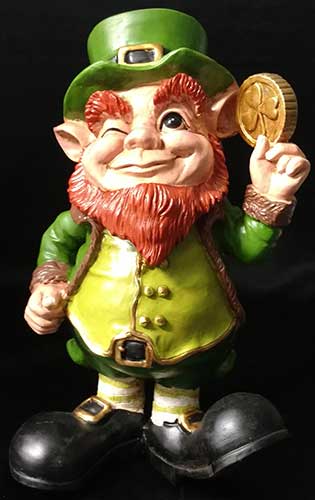
From  advertising schemes to cartoons and movies the Leprechaun has been a pop-culture image for many many years now in fact the image of the leprechauns is now one of  the most recognizable images from  Irish folklore.

Among  the Fairy courts the Leprechaun is perhaps the most well know  fay second only too the Fairy's..(Tinkerbell etc )


 A leprechaun is a type of fairy and a member of the Aos Sí in Irish mythology. 

They are most often depicted as small bearded men, wearing a coat and hat, and are said to be found of pranks and mischief. 

They are usually  solitary creatures who spend their time making and mending shoes and have a hidden pot of gold at the end of the rainbow.

                                                     Image result for leprechaun


 ===================


Leprechaun myth's and folklore------

 
The earliest known reference to the leprechaun appears in the medieval tale known as the Echtra  Fergus mac Leti (Adventure of Fergus son of Léti).

 The text contains an episode in which Fergus mac Leti the  King of Ulster, falls asleep on the beach and wakes to find himself being dragged into the sea by three lúchorpáin. He captures his abductors, who grant him three wishes in exchange for release.

The leprechaun is said to be a solitary creature, whose principal occupation is making and mending shoes, and who enjoys practical jokes. According to William Butler Yeats  the great wealth of these fairies comes from the "treasure - crocks, buried of old in war-time", which they have uncovered and appropriated.

 According to David Russell McAnally the leprechaun is the son of an "evil spirit" and a "degenerate fairy" and is "not wholly good nor wholly evil".

 ----------------------------

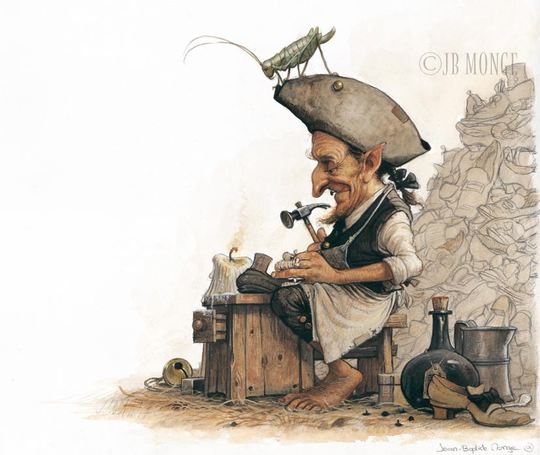
Some researchers say that the word leprechaun may have be derived from the Irish leath bhrogan, which means shoemaker.  they are cobblers, or shoemakers. Shoemaking.


                                                             Image by JB Monge
            

------------
Image result for leprechaun shoe next to htumble
According to Irish legends, people lucky enough to find a leprechaun and capture him (or, in some stories, steal his magical ring, coin or amulet) can barter his freedom for his treasure. Leprechauns are usually said to be able to grant the person three wishes. But dealing with leprechauns can be a tricky proposition.

 ----------------------
                                   Image result for leprechaun shoe ireland

Very small shoe made of mouse leather found by a sheep farmer on an ancient trail within the Beara Peninsula in Ireland.1824... (Post about this coming soon)
---------------------


 Leprechauns.....

The name leprechaun is derived from the Irish word leipreachán, defined by Patrick Dinneen  as "a pigmy, a sprite, or leprechaun". The further derivation is less certain; according to most sources, the word is thought to be a corruption of Middle Irish  luchrupán, from the Old Irish   luchorpán, a compound of the roots ("small") and corp ("body").

 The root corp, which was borrowed from the Latin   corpus, attests to the early influence of   Ecclesiastical  Latin on the Irish language.

 However, further research published in 2019 suggests that the word derives from the Luperci and the associated Roman festival of Lupercalia.

The alternative spelling leithbrágan deriving the word from leith (half) and bróg (brogue), because of the frequent portrayal of the leprechaun as working on a single shoe.

Alternative spellings in English have included lubrican, leprehaun, and lepreehawn. Some modern Irish books use the spelling lioprachán. The first recorded instance of the word in the English language was in Dekker's comedy The Honest Whore, Part 2 (1604): "As for your Irish lubrican, that spirit / Whom by preposterous charms thy lust hath rais'd / In a wrong circle.

 Some believe  that leprechauns are descended from the Tuatha de Danann. When the Milesians came to Ireland (according to the Book of Invasions) they conquered the Tuatha de Danann and forced them to live under ground (this connects them to the aes-sidhe).


---------
 The cluricaun is often confused with the leprechaun. The leprechaun is related to the clurichaun and the far darrig in that he is a solitary creature. Some writers even go as far as to substitute these second two less well-known spirits for the leprechaun in stories or tales to reach a wider audience. The cluricaun is considered by some to be merely a leprechaun on a spree.
 ------------------


Leprchuans love music, dancing, fox hunting, and drinking Irish whiskey these are said to be the his ' favorite pastimes.

Once a leprachaun begins dancing to a human's song, it is said that he cannot stop until the tune ceases.

 His exhausted state may cause him to make outlandish offers, including his crock (pot)of gold, if you will please only allow him to stop dancing. Other means of finding his gold include looking at the end of a rainbow, which may lead him to offer 3 wishes in exchange for his treasure. However his promises of gold or wealth  are nothing more the  hollow words, as the Leprechaun employs clever trickery when granting his  wishes, usually resulting in the embarrassment or even  injury to the one making the wishes.

According to some legends, If caught by a human, he will promise great wealth if set  free.

He carries two leather pouches. In one there is a silver shilling, a magical coin that returns to the purse each time it is paid out. In the other he carries a gold coin which he uses to try and bribe his way out of difficult situations. This coin usually turns into leaves or ashes once the leprechaun has parted with it. However, you must never take your eye off him, for he can vanish in an instant.
According to legend, if anyone keeps an eye fixed upon one, he cannot escape, but the moment the eye is withdrawn he will vanish.


==========
--Other Media---


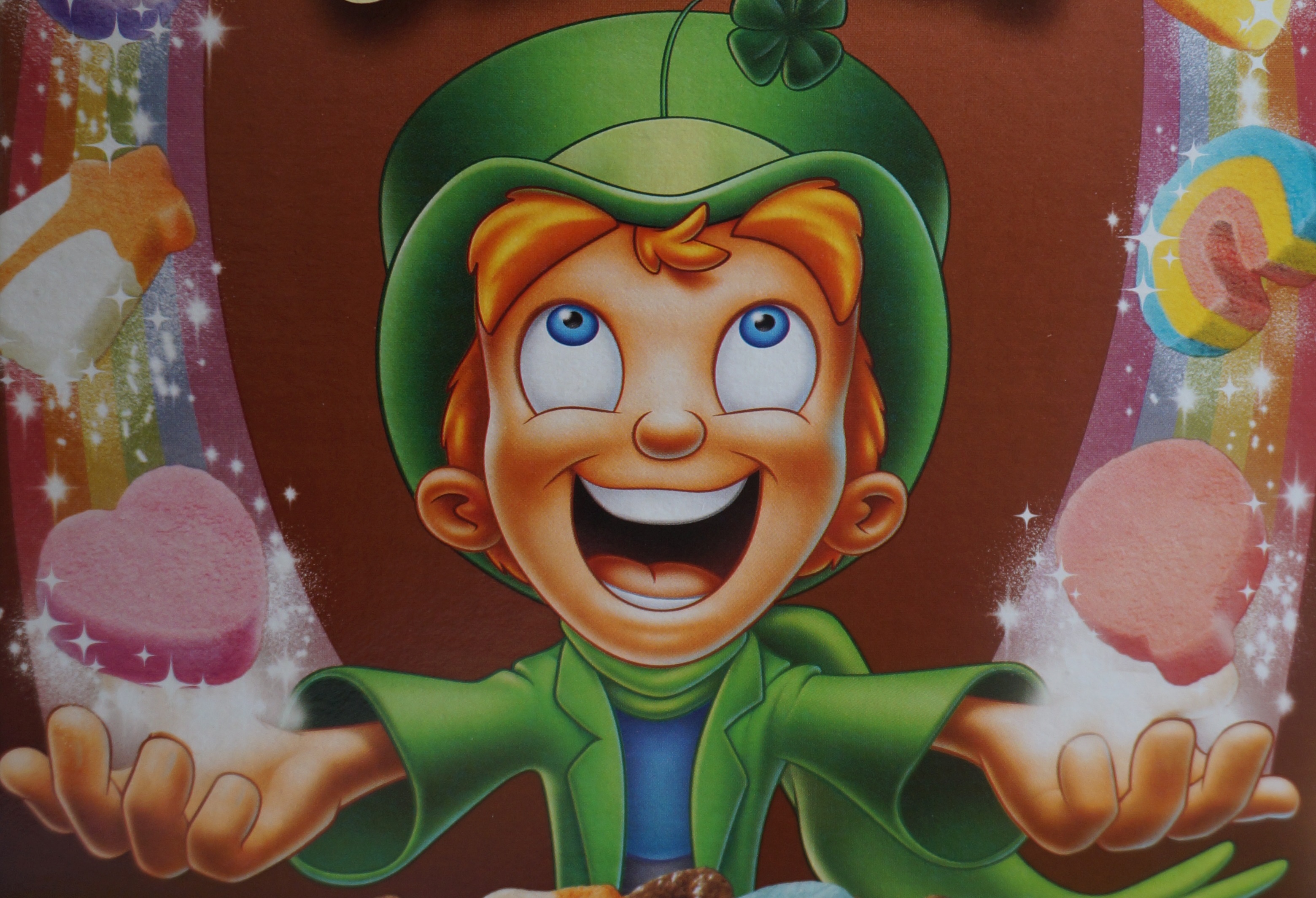
As with many old legends and traditions, the image and nature of the leprechaun has changed over time and has been updated for a modern audience. Lucky the Leprechaun, mascot of the General Mills breakfast cereal Lucky Charms, is probably the best-known fairy of his type.

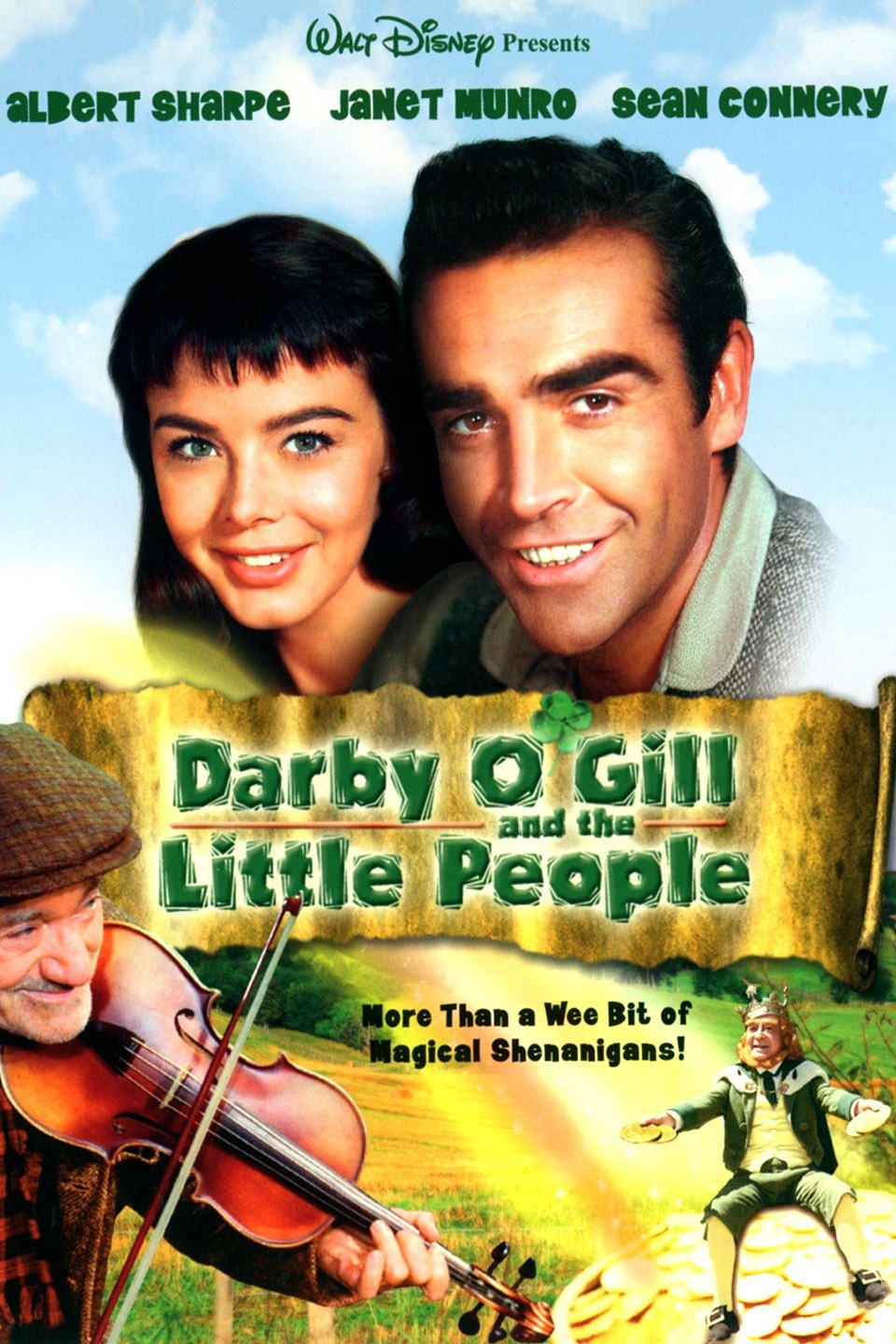
The 1959 Disney movie Darby O'Gill and the little people also played  an prominent role  how people see the wee folk today.
                                             .
---------------Image result for darby ogill


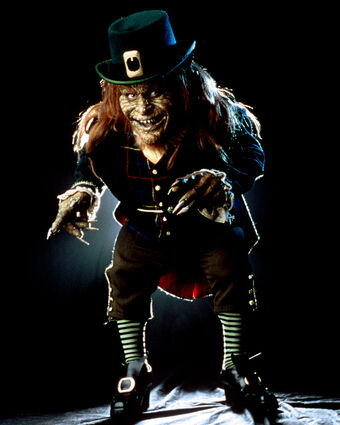
Then there's  homicidal leprechaun Lubdan in the "Leprechaun" horror/comedy film series played by "Willow" actor Warwick Davis.
 -----------------
                                 Image result for leprechaun

 ===========================


One of the most well know Leprechauns in the world is Lucky the General Mills cereal mascot for Lucky Charms.

                                             =================
                                     -----Lucky the Leprechaun -----


         Image result for lucky charms

=====================


                                                  =============
                                                        Hornswaggle
                                                       ==========

Image result for hornswoggle wwe


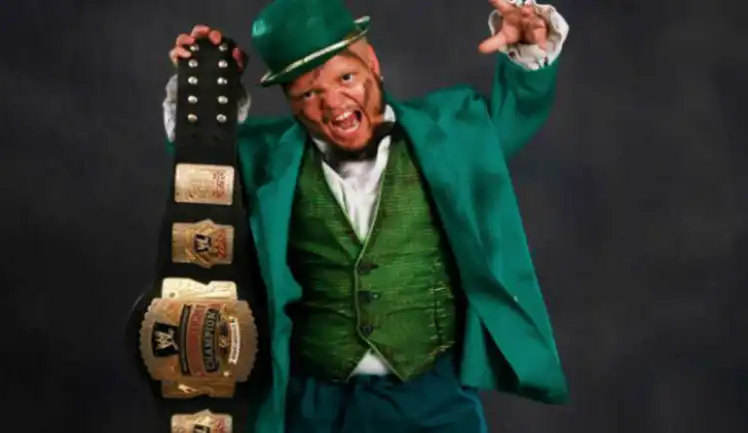
Professional wrestler Dylan Mark Postl competed and appeared as Hornswoggle the little leprechaun that lived under the ring, for most of his WWE career 


========


The University Notre Dame- Fighting  Irish Leprechaun mascot 


Image result for fighting irish


============================


The Boston Celtics logo has a leprechaun mascot of the team named  Lucky the Leprechaun...no relation to General Mills or Lucky Charms...
Image result for celtics
--------------------------

                                          Cute female Leprechaun ...

                           Leprechaun Fairy Goth Girl with Shamrocks

                             Image result for leprechaun girl


Leprechaun in anime
                                           Image result for leprechaun aniume


  Image result for leprechaun animeShuumatsu Nani Shitemasu ka? Isogashii Desu ka? Sukutte Moratte Ii Desu ka? WorldEnd: What do you do at the end of the world? Are you busy? Will you save us?
 Chtholly Nota Seniorious  from Shuumatsu Nani Shitemasu ka? Isogashii Desu ka? Sukutte Moratte Ii Desu ka?
  
 WorldEnd: What do you do at the end of the world? Are you busy? Will you save us?


================
Leprechaun and Politics....
---------------------------------------

Paul Krugman  a Nobel Prize-winning economist, first coined the term "Leprechaun economics" to describe distorted or unsound economic data, which he first used in a tweet on 12 July 2016 in response to the publication by the Irish Central Statistics Office or CSO..that Irish GDP had grown by 26.3%, and Irish GNP had grown by 18.7%, in the 2015 Irish national accounts. The growth was subsequently shown to be due to Apple restructuring its double Irish  tax scheme which the EU Commission had fined €13bn in 2004–2014 Irish unpaid taxes, the largest corporate tax fine in history. The term has been used many times since.


 In the Irish politics the  leprechauns has been used to refer to the twee (a childish pronunciation of sweet).  aspects of the tourist industry in Ireland This can be seen from this example of  John A Costello addressing the Oireachtas   in 1963: "For many years, we were afflicted with the miserable trivialities of our tourist advertising. Sometimes it descended to the lowest depths, to the caubeen and the shillelagh  not to speak of the leprechaun


               Image result for leprechaun girl


Monday, March 2, 2020

Fairy Lore: Wind Sylph

                                                            The Sylph..

============================
//////St Patrick's day is March 17th so March is going to be all  about the Little People, Pixie's, Fairy's, Spirits,.. Leprechauns ect ...
==============================

The Sylph...

 A Wind Sylph is a type of Elemental being associated with Air/ wind.

The Sylph  has appeared in many  classic and modern forms of  literature, Theater, TV  and Games.

Some examples are the board game  Dungeons and Dragons . and a Japanese Anime and Manga called The Ancient Magus Bride.  even the Ariel from William Shakespeare: The Tempest.


The word sylph  is possibly a portmanteau (Blend of Words)  derived  from the Latin sylvestris and nympha  sylvestris being a common synonym for sylph in Paracelsus. Anthon and Trollope note a similar usage in the Aeneid  where silvestris is taken as an elliptical form of nympha silvestris ("forest nymph").Jacob Grimm (Of the Brothers Grimm )  uses this phrase as a gloss for the Anglo-Saxon wudu-mær (roughly equivalent to "woodmare"), which he also takes as a metaphorical name for an echo

 ===========
Sylph's in DnD lore ..
============
 Sylphs are beautiful, humanoid women with wings like dragonflies. Their wings are 4-5 feet long and translucent, clear, or spotted with iridescent color. Their long, bright, hair may be any “normal” color, or blue, purple, or green. They wear flowing, diaphanous robes which accent their wings or hair. Sylphs are related to air elementals and nymphs, possibly even originating as a cross-breed between nymphs and aerial servants. They speak Common and their own musical language.
-------------------------------------
                                                      Sylph by Fernosaur on DeviantArt Character Creation, Character Concept, Character Art, Character Design, Dungeons And Dragons Characters, Dnd Characters, Fantasy Characters, Fantasy Creatures, Mythical Creatures

Image from pintrist art by Paizo's Pathfinder. Corel Painter. (c) Paizo. Sylph

==========
===
=

 In the 1778 British novel (The Sylph)  a sylph appears as a guardian spirit for the female lead
 ----

The  famous ballet La Sylphide  "The (Female) Sylph", Paris, 1832) is a prominent example of sylph lore in classic theater during the 19th century.

It appeared in a second version in Denmark in 1836.

Other famous opera's of the 18th and early 19th century are The Mountain Sylph from 1834. Sylphs and  the 1909 ballet  Les Sylphides.


----------------

The Paracelsian concept of elementals is  draws from several much older traditions in mythology and religion. Common themes can be found in folklore all over the world.

Some examples of elemental creatures such as the Pygmy were taken from Greek Mythology.

The four main types of spirit elementals or earth, water, air, and fire, they are  classed as the fundamental building blocks of nature.
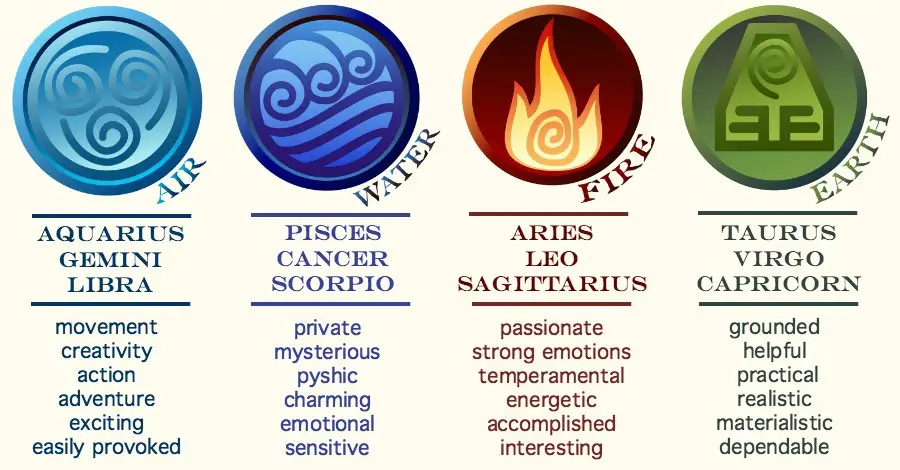


Image result for earth fire air water

-------------------
This system  was highly influential in the development of medieval nature philosophy . Although Paracelsus uses these foundations and the popular preexisting names of elemental creatures, he is doing so to present new ideas which expand on his own philosophical system. The homunculus  is another example of a Paracelsian idea with roots in earlier alchemical, scientific, and folklore traditions.


                                              The Alchemist  Paracelsus


In his 16th-century  alchemical work Liber de Nymphis, sylphis, pygmaeis et salamandris et de caeteris spiritibus Paracelsus  identified the mythological beings as belonging to one of the four elements. Part of the Philosophia Magna, this book was first printed in 1566 after Paracelsus' death.  He wrote the book to "describe the creatures that are outside the cognizance of the light of nature, how they are to be understood, what marvelous works God has created".

                       Image result for Liber de Nymphis, sylphis, pygmaeis et salamandris et de caeteris spiritibus Paracelsus

He states that there is more bliss in describing these "divine objects" than in describing fencing, court etiquette, cavalry, and other worldly pursuits.  The following is his archetypal being for each of the four elements: Earth, Water, Air and Fire..


                                                           Other Alchemist symbols 
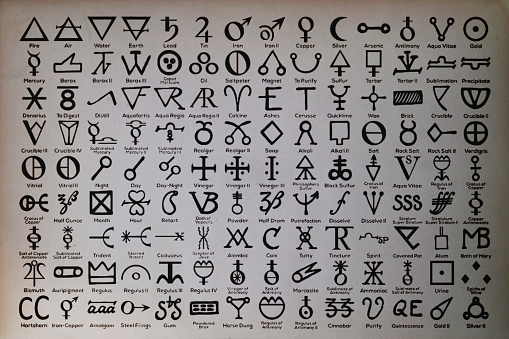


                           Image result for wind symble alchemy


The concept of elementals seems to have been conceived by Paracelsus in the 16th century, though he did not in fact use the term "elemental" or a German equivalent.

 He regarded them not so much as spirits but as beings between creatures and spirits, generally being invisible to mankind but having physical and commonly humanoid bodies, as well as eating, sleeping, and wearing clothes like humans. Paracelsus gave common names for the elemental types, as well as correct names, which he seems to have considered somewhat more proper, "recht namen".

He also referred to them by purely German terms which are roughly equivalent to "water people," "mountain people," and so on, using all the different forms interchangeably. His fundamental classification scheme on the first page of Tractatus II of the Liber de Nymphis is based on where the elementals live, and he gives the following names:


  • Gnomes being of earth
  • Undine  being of water
  • Sylph being of air 
  • Salamander  being of fire
Gnomus, Undina and Sylph   are all thought to have appeared first in Paracelsus' works, though undina is a fairly obvious Latin derivative from the word unda meaning "wave."
In De Meteoris he referred to the elementals collectively as Sagani.

He noted that undines are similar to humans in size, while sylphs are rougher, coarser, longer, and stronger. Gnomes are short, while salamanders are long, narrow, and lean. The elementals are said to be able to move through their own elements as human beings move through air. Gnomes, for example, can move through rocks, walls, and soil. Sylphs are the closest to humans in his conception because they move through air like we do, while in fire they burn, in water they drown, and in earth, they get stuck. Paracelsus states that each one stays healthy in its particular Chaos  as he terms it, but dies in the others.

Paracelsus conceived human beings to be composed of three parts, an elemental body, a sidereal spirit, and an immortal divine soul. Elementals lacked this last part, the immortal soul. However, by marriage with a human being, the elemental and its offspring could gain a soul.
Because of their association with the ballet La Sylphide, where sylphs are linked with fairies  along with  the medieval legends of fairyland, as well as a confusion with other "airy spirits" (e.g., in William Shakespeare's  A Midsummer Nights Dream were a petite  girl may be referred to as a sylph.


The word Sylph  made it's way into general language as a term for minor spirits, elementals, or faeries of the air.

Some Sci-Fi and Fantasy authors will sometimes employ sylphs in their fiction, for example creating giant artistic clouds in the skies with fairy wings.


========
These month my post's will be regarding the wee folk, fairy's, gnomes, elf's and the like...  hope you all enjoy :)

and

Thank you to those of you who share my posts much appreciated !