Showing posts with label yule. Show all posts

Thursday, December 19, 2024

Kallikantzaroi, Christmas Goblin's 🎄🇬🇷


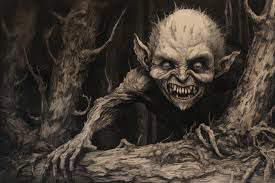
The Kallikantzaroi is a goblin like creature from Greek folklore.


 They live underground most of the year and spend their time sawing away at the world tree trying to bring it down and the world with it,  only coming out during the twelve days of Christmas, from December 25th to January 6th. 


They are small creatures  most often described as goblins or tiny demons with tails,  long, shaggy hair and hooves for feet.

 Despite their monstrous appearance, they are mostly prankster not good, but not entirely evil, however their mischievous behavior during the Christmas season can be troublesome similar to the pranks played by the Yule lad's.


 They're pranks usually involve stealing peoples belongings, and messing with  food. 

 There are several customs and rituals to keep them away,  including leaving a fire burning in the hearth throughout the night to prevent the Kallikantzaroi from entering through the chimney,  hanging holly and garlic, and placing a colander on the doorstep are some methods  believed to keep the Kallikantzaroi at bay.


They're pranks will continue until the Feast of the Epiphany, celebrated on January 6th. As the waters are blessed during the Epiphany service, the Christmas goblins return to they're underground home only to resurface the following year when the holiday season arrives once again.

,..............................


⛄Merry Christmas 🎄

And 

Happy New Year

🎆🎇🎆🎇🎆🎇🎆🎇


Thursday, December 21, 2023

The Yule Lads, Iceland's 13 Santa's.

  ❄️❄️❄️❄️❄️❄️❄️🎄❄️❄️❄️❄️❄️❄️❄️   


Iceland does not have a Santa Clause instead they have Christmas troll's .


The 13 Yule Lads  take turns to visit kids on the 13 nights leading up to Christmas


Instead of a Christmas stocking hung by the fire place children in Iceland keep one of their shoes on the windowsill where the Yule Lad will either leave candy or old  potatoes  depending on whether the kids have been good or bad.


The Yule Lads were originally either some what violent or just normal  pranksters depending on the region or who was telling the story. 

Iceland outlawed frightening children's stories in the 1700s after that the Yule Lads took on a more Santa like roll and are now a type of Christmas Troll's.


 They all have special name, that describes their favorite kind of mischievous behavior. 


Their names are:


Stekkjastaur- Sheep-Cote Clod


Giljagaur - Gully Gawk


Stúfur - Stubby


Þvörusleikir - Spoon Licker


Pottaskefill - Pot Scraper


Askasleikir - Bowl Licker


Hurðaskellir - Door Slammer (he loves waking people up by slamming doors)


Skyrgámur - Skyr Gobbler


Bjúgnakrækir - Sausage Swiper


Gluggagægir - Window Peeper


Gáttaþefur - Doorway Sniffer


Ketkrókur - Meat Hook


Kertasníkir - Candle Beggar


They are the children of  Grýla and Leppalúði


Two trolls you don't want to meet, especially Grýla.  You should also try to avoid their family pet the Yule Cat as it has been known to eat people.. Grýla is also well known for kidnapping and eating kids.


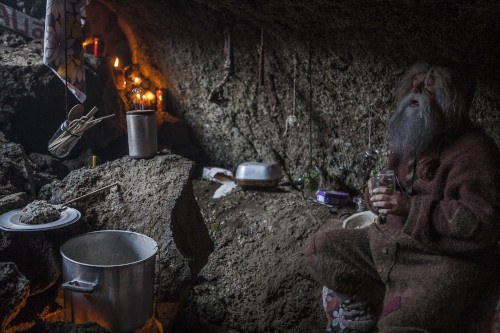
The Yule Lads live I northern Iceland in Myvatn at Dimmuborgir in an natural volcanic cave. They spend most of the summer sleeping there and seldom ever leave until winter.

The name of the cave translates to Dark Cities or Dark Fortress.


It seems at one point in the far past there were around 70 children of Grýla but these 13 are all that's left, or at least the ones most remembered.


Hope you've been good this year, you Really don't want Grýla showing up 👹


Have a great Christmas and New Year

🎄⛄


Tuesday, December 13, 2022

The Yule Log 🎄


                                           Magic Yule Logs Rainbow Flames (Bundle of 3) - TOPS Malibu

                       🎄The Yule Log🔥


Norway is the birthplace of the Yule log

  The ancient Norse used the Yule log in their celebration of the return of the sun at winter solstice. “Yule” came from the Norse word hweol, meaning wheel. 

The Norse believed that the sun was a great wheel of fire that rolled towards and then away from the earth.


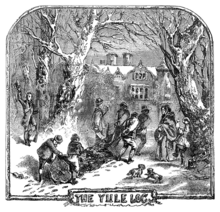
The Yule log was a long oak tree carved with runes (early norse/germanic letters) to wish for the protection of the gods and burned for the duration of the celebration. To let it go out was said to be a dark omen and a sign of bad luck to come.  

The Vikings would save a piece of the log for next year's fire.


The UK Tradition.


The Yule log, Yule clog, or Christmas block is a specially selected log burnt on a hearth as a winter tradition in regions of Europe, particularly the United Kingdom, and subsequently North America. 

The origin of the folk custom is unclear. Like other traditions associated with Yule (such as the Yule boar.


 The Christmas practice calls for burning a portion of the log each evening until Twelfth Night (January 6th. 


The log is subsequently placed beneath the bed for luck, and particularly for protection from the household threats of lightning and, with some irony, fire. Many have beliefs based on the yule log as it burns, and by counting the sparks and such, they seek to discern their fortunes for the new year and beyond


 the Yule log, Yule goat, and Yule boar (Sonargöltr) are still reflected in the Christmas ham, Yule singing, and others, which Simek takes as "indicat[ing] the significance of the feast in pre-Christian times.


Tuesday, December 17, 2019

Christmas: Krampus the Christmas Demon.


                                                       Krampus the Christmas Demon.


Krampus can be found in the folklore of many different European country's ... Austria, Bavaria, Croatia, Czech Republic, Hungary, North Italy, Slovakia, and Slovenia.

His exact origin is unclear; some folklorists believe it to  have pre-Christian roots.

There are various traditional parades and events, a well known one is  the Krampuslauf (English: Krampus run), mostly young men dressed as Krampus to participate this is an annually  event  in most Alpine towns. 

 Krampus is also featured on holiday greeting cards called Krampuskarten.


By the 17th century Krampus had been incorporated into Christian winter celebrations by pairing Krampus with St. Nicholas.

Countries of the former Habsburg Empire  have largely borrowed the tradition of Krampus accompanying St. Nicholas on December  5th from Austria.


 A more  recent myth is that Krampus was the son of Hel the Norse goddess of the underworld, this myth  has been popularized on the internet, even appearing in an  articles in National Geographic and Smithsonian Magazine.

 However, this connection is likely the invention of the American fantasy artist and author Gerald Brom whose 2012 novel Krampus the Yule Lord features Krampus as the main protagonist.

The same idea also appeared shortly afterwards in two online games by the Norwegian games producer Funcom.


==============


Krampus, seems to the most popular holiday monster or at least one of the most well known he si described as a half-goat, half-demon, said to be hairy, usually brown or black, and has the cloven hooves  and the  horns of a goat. His long, pointed tongue hangs out, and he has fangs.

Krampus literally beats people into being nice.
He arrives with a chain  that he swings around, along with a bundle of birch sticks meant to swat ill behaved children. He carry's the bad kids down to the underworld

 Well Santa or St. Nicholas is the patron saint of children. ..Krampus is more of an anti Santa..

This yuletide demon was often seen accompanying  St. Nicholas on his Christmas journey from house to house.

However well St Nick rewarded well behaved children with sweets and toys Krampus. would beat the bad  kid's, stuff them in a sack, and take them away to his lair.


.............................................
================
      Celebrations...
===============


                                   Krampusnacht--Krampus Night and the  Krampus Run/parade

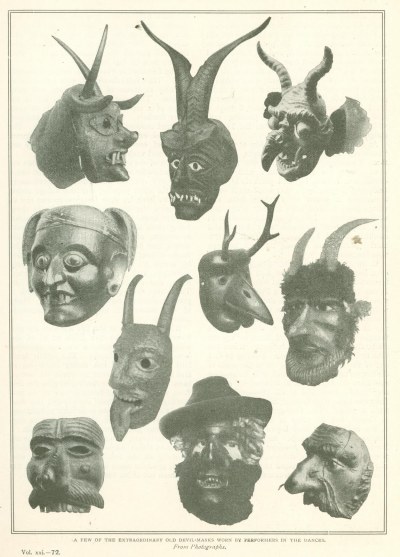
People have been dressing up like Krampus for centuries. During the fifteenth and sixteenth centuries, devil masks were used at winter church plays.


                                                          Old wooden Krampus masks...

On Krampusnacht in modern times, men dress up in Krampus costumes made of sheepskin. Women sometimes dress up as a Nordic figure named Frau Perchta.

This time of the year there are parades and parties and a lot of them  often have a  Krampuslauf—or Krampus Run—where people run through the streets dressed as Krampus.

The day has increasingly become commercialized. Krampus has appeared on cards and ornaments over the years. He has also been  graphic novels, television shows, video games, and movies.

Krampus night  is held annually on December 5th.

The next Krampusnacht, --- Krampus Night, will be on Saturday, December 5th, 2020.

The next day December 6th is The Feast of St Nickolas ...
-----------------------------


                                                         St. Nickolas vs Krampus

There is also  a seasonal play that spread throughout the Alpine regions it was known as the Nikolausspiel ("Nicholas play").

Inspired by Paradise plays, which focused on Adam and Eve's encounter with a tempter, the Nicholas plays featured competition for the human souls and played on the question of morality.

In these Nicholas plays, Saint Nicholas would reward children for scholarly efforts rather than for good behavior. 

 This is a theme that grew in Alpine regions where the Roman Catholic Church  had significant influence.

There were already established pagan traditions in the Alpine regions that became intertwined with Catholicism. People would masquerade as a devilish figure known as Percht, a two-legged humanoid goat with a giraffe-like neck, wearing animal furs.

 People wore costumes and marched in processions known as Perchtenlaufs, which are regarded as any earlier form of the Krampus runs. Perchtenlaufs were looked at with suspicion by the Catholic Church and banned by some civil authorities. Due to sparse population and rugged environments within the Alpine region, the ban was not effective or easily enforced, rendering the ban useless. Eventually the Perchtenlauf, inspired by the Nicholas plays, introduced Saint Nicholas and his set of good morals. The Percht transformed into what is now known as the Krampus and was made to be subjected to Saint Nicholas' will

=====================

Krampus has appeared in several tv shows and movies even a Christmas ep of The Venture Bothers..


=========================================
=========== VINTAGE Krampus Christmas Cards====
=========================================


This is my last post before Christmas, hope you all have a great holiday and a Happy New Year Merry Christmas!! and thank you for an awesome 2019! :)