Showing posts with label pagan. Show all posts

Saturday, August 1, 2026

Paranormal Folklore and Mythology, Lughnasadh / Lammas.


According to Irish Mythology and the pagan wheel of the year Lughnasadh was a Celtic  holiday founded by the god Lugh as  a  funeral feast and athletic competition and Funeral games to commemorate the death of an earth goddess.

On the Celtic/ pagan calendar  Lughnasadh is a holiday that coincides with Lammas celebrating the first harvest.

Both ancient celebrations are traditionally  held on August 1st...


Lammas often overlaps with or is used interchangeably with Lughnasadh. It's one of the eight major Sabbats on the Pagan Wheel of the Year, honoring the importance of the grain harvest and Mother Earth's bounty. Early Irish Christians celebrated the first bountiful grain  harvest of the year by consecrating freshly baked loaves of bread during a church service.🥐🥖🍞


Other variations of the word are Lunasa, Luᵹ̇nasaḋLughnasadh and Lughnasa.

In Modern Irish, the spelling is Lúnasa  which is also the name for August, Mí Lúnasa (Month of August) and Lá Lúnasa (Day of Lúnasa).  In Modern Scottish Gaelic (Gàidhlig), the festival and the month are both called Lùnastal  In Manx (Gaelg), the festival and the month are both called Luanistyn

The competition usually consist of multiple events  including matchmaking, horse racing, hurling, trading and of course a large feast.

Originally religious rites included an offering of the First Fruit of the grain harvest, a feast of the new food,  sacrificing a bull, ( no longer practiced) followed by a ritual dance.

Original festivals where held on top of hills, this tradition of climbing hills and mountains at Lughnasadh is still practiced in some areas and is recast as a Christian pilgrimage. The best known is the Reek Sunday pilgrimage to the top of Croagh Patrick on the last Sunday in July. 

One custom Lughnasadh had in common with Imbolc and Beltane was visiting holy wells,  specifically clootie wells. Visitors  would pray for health while walking sunwise around the well; they would then leave offerings, usually coins or clooties. Although bonfires were lit at some of the open-air gatherings in Ireland, they were rare and not important to the celebrations itself.

Traditionally, the holiday was celebrated on  the first day of August.  Though after the christianization of Ireland  most of the  festivities where changed to the nearest Sundays – either the last Sunday in July or first Sunday in August.

Since the late 20th century, Celtic neopagans have observed Lughnasadh as a religious holiday. Other names for the festival are Mountain Sunday, Garland Sunday and Bilberry Sunday.

A common theme in the story of  is the tragic fate of a woman who is carried off or held against her will, and later dies out of shame, exhaustion grief , or an unspecified natural cause.

Another version regarding the  Lughnasadh site of Tailtin says the festival was founded by Lugh as funeral games in memory of his foster-mother tailtiu. 

Folklore  says she died of exhaustion after clearing the plains of Ireland for agriculture.  Tailtiu may have been an earth goddess who represented the dying vegetation that fed mankind.  Another tale, about the assembly site of Nass,, says that Lugh founded the festival in memory of his two wives, the sisters Nas and Bói.  One theory is that it was a mourning (or wake) for the end of summer. There are several different versions of it's origins. 

Another goddess associated with  Lughnasadh is Áine ..

She is an Irish Goddess of the Summer Solstice and of Lughnasadh who brings love, protection, fertility, wealth and sovereignty. 

As a Moon Goddess she is the guardian of  livestock, crops, and cattle and as a Sun Goddess, she takes the form of ‘Lair Derg’, The Red Mare so fast that no one can outrun. In  this form she travels the country bringing blessings to everyone.


🏵️🥖🍞🥐🍁🇮🇪☘️👨‍🌾🌾


Tuesday, February 17, 2026

Fornax, Roman Goddess of baking


Ancient Rome is full of Gods and Goddesses for nearly every occasion or occupation.

Fornax is the patron goddess of baker's.

She is the goddess of ovens and baking, responsible for bread, buns, toast, muffins, and bagels. She was also essential for preventing burnt offerings and house fires. 

Originally, Roman ovens were used for toasting grain, while the  hearth was used for  baked bread. Though as ovens became more commonly used for baking instead of a Traditional Hearth , Fornax myth was eventually merged with the goddess Vesta. 


Fornacalia is a festival held in honor of Fornax, where grain is toasted for the salted meal mola salsa. 


Originally she was the patroness of bakers, and a goddess of baking. She ensured that the heat of ovens did not get hot enough to burn the corn or bread.

People would pray to for help whilst baking.

 Her festival, the Fornacalia, is  celebrated on February 17.

............

 Vesta  is the virgin goddess of the hearth, home, and family in Roman religion, most often depicted as a flame and on rare occasions in a human form.

More on her in a later post.


Sunday, February 1, 2026

Sol-mōnaþ / Solmonath.. Month of Cake.


February 1st marks the beginning of Sol-mōnaþ (or Solmonath) 

In the old Angelo Saxon calendar Sol is the month between Gēola (January) and Hreð-monaþ (March). 

This is the Anglo-Saxon name for what we call February, translating to "month of the hearthcakes". While "sol" sometimes refers to mud, or even melting snow, in this context it signifies "hearthcake," these are cakes baked on a traditional hearth. 


This practice was recorded by the scholar Bede, it comes from a time when theses cakes where offered to the gods as thanks and to honor them 


..

Sol also translates to Sun and could be considered Sun Month.


Not to be confused with Sol Month from the proposed  13 month international calendar 


A 13-month calendar, like the proposed International Fixed Calendar (Cotsworth Plan) by Moses B Cotsworth.

This plan divides the year into 13 months of exactly 28 days (four 7-day weeks), totaling 364 days, with an extra "year day" added annually and a leap day every four years, offering perpetual consistency where dates always fall on the same day of the week, though it requires adjustment for the solar year and faces challenges with the current 12-month system.
 It was heavily pushed by George Eastman in the 1920's in the United States, put never gained international attention.

It was used by Kodak from 1924 until 1989.

Sunday, December 18, 2022

Frau Perchta, Christmas Witch.


Frau Perchta


Frau Perchta was also known as Berchta, or Bertha, and has also been called “Spinnstubenfrau” or “Spinning Room Lady.”
 

She is often depicted with a beaked nose made of iron, dressed in rags, sometimes  carrying a cane, and usually resembles a  old woman.


In some descriptions, she has two forms; she may appear as either a beautiful young woman with skin and hair as white as snow, or as elderly and haggard.

In the Tyrol she appears as little old woman with a very wrinkled face, bright lively eyes, and a long hooked nose; her hair is disheveled, her garments  tattered and torn.


In many old descriptions, Perchta had one large foot, sometimes called a goose foot or swan foot.

Grimm thought the strange foot symbolized her being a higher being who could shapeshift to animal form. He noticed that Bertha with a strange foot exists in many languages (Middle German "Berhte mit dem fuoze", French "Berthe au grand pied", Latin "Berhta cum magno pede",  Italian " Berta dai gran piè", title of a medieval epic poem of Italian area): "It is apparently a swan maiden's foot, which as a mark of her higher nature she cannot lay aside...and at the same time the spinning-woman's splayfoot that worked the treadle".


Perchta had many different names depending on the era and region: Grimm (The Brothers Grimm) listed the names Perahta and Berchte as the main names
followed by Berchta in Old High German, as well as Behrta and Frau Perchta.

In Baden, Swabia, Switzerland and Slovenian regions, she was often called Frau Faste (the lady of the Ember days) or Pehta or 'Kvaternica',
in Slovene. Elsewhere she was known as Posterli, Quatemberca and Fronfastenweiber.


Percht and other variations, was once known as a goddess in Alpine paganism in the Upper German and Austrian regions of the Alps. Her name may mean
 "the bright one" Perchta may also come from an  Old High German verb pergan, meaning "hidden" or "covered


She also bears a resemblance to the Scandinavian goddess Frigga, and both of them share a common trait: spinning, specifically, and domestic neatness  general.


Other legends equate Frau Perchta with the legend of the Wild Hunt, and say that she flies through the night sky followed by an army of lost souls,  including the demonic-looking Perchten, her army of servants who are almost identical in appearance to Krampus.

The only difference is that Krampus rides abroad at St. Nicholas Eve while the Perchten travel  closer too Epiphany, and the last three Thursdays before Christmas, also known as Berchtl nights or Knocking nights.


Also among her army of the night are the souls of unbaptized children. Legend has it if you hear the wind and thunder roaring and rumbling through the  mountains on the Berchtl nights, you’re really hearing the sounds of Perchta leading the Wild Hunt.


Another one of Frau Perchta’s names is Holle, a winter goddess who’s name means “shining” or “bright” — hence her association with Epiphany, the “Shining Night” on which the star of Bethlehem shone down.


Her dual nature is expressed in the fact that there are both “Evil” or “Ugly” Perchten and “Pretty” Perchten, both of whom you might find in a typical “Perchtenlauf” or Perchten run in the Alpine regions of Europe.

                                                 File:Perchtenmasken Salzburg.jpg - Wikimedia Commons

In Austria, particularly Salzburg, where she is said to wander through Hohensalzburg Castle in the dead of night,  the Perchten are still a traditional part of  holidays and festivals (such as the Carnival Fastnacht). The wooden  masks made for the festivals are today called Perchten.

In the Pongau region of Austria large processions of Schönperchten ("beautiful Perchten") and Schiachperchten ("ugly Perchten") are held every winter.

Beautiful masks are said to encouraging financial windfalls, and the ugly masks are worn to drive away evil spirits.


Other regional variations include the Tresterer in the Austrian Pinzgau region, the stilt dancers in the town of Unken, the Schnabelpercht or Schnabelperchten  ("trunked Percht") in the Unterinntal region and the Glöcklerlaufen ("bell-running") in the Salzkammergut.

A number of large ski-resorts have turned the tradition into a tourist attraction drawing large crowds every winter. 

She's Coming To Rip Out Your Organs And Replace Them With Garbage – Merry  Christmas From Frau Perchta!


In southern Austria, in Carinthia there is  a male form of Perchta called  Quantembermann, in German, or Kvaternik, in Slovene (the man of the four Ember days).

Grimm thought that her male counterpart or equivalent is Berchtold.

Regional variations of the name include Berigl, Berchtlmuada, Perhta-Baba, Zlobna Pehta, Bechtrababa, Sampa, Stampa, Lutzl, Zamperin, Pudelfrau,  Zampermuatta and Rauweib.

                     Perchta: Evil Witch Of The Alps - An Old Tradition That Still Continues -  Ancient Pages

Perchta was the upholder of cultural taboos, such as the prohibition against spinning on holidays.

In  Bavaria and Austria folklore, Perchta was said to roam the countryside at midwinter, and to enter homes during the twelve days between Christmas and Epiphany (especially on the Twelfth Night).

She would know whether the children and young servants of the household had behaved well and worked hard all year.

If they had, they might find a small silver coin the next day, in a shoe or pail.


If they had not, she would slit their bellies open, remove their stomach and guts, and stuff the hole with straw and pebbles.
                                              The Myth of Frau Perchta – The Storied Imaginarium


She is manly focused on whether or not  girls had spun the whole of their allotted portion of flax or wool during the year.

 
She would also slit people's stomachs open and stuff them with straw if they ate something on the night of her feast day, other than the traditional meal of fish and gruel.


There was even a  cult dedicated to Perchta, the followers would leave food and drink's for Frau Percht and her followers in the hope of receiving wealth and good fortune, it was later condemned in Bavaria in the Thesaurus pauperum (1468) and by Thomas Ebendorfer von Haselbach in De decem praeceptis (1439).


Later canonical and church documents characterized Perchta as synonymous with other leading female spirits: Holda, Diana, Herodias, Richella and Abundia


According to Jacob Grimm and Lotte Motz, Perchta is Holda's southern cousin or equivalent, as they both share the role of "guardian of the beasts"  and appear during the Twelve Days of Christmas, when they oversee spinning.


Grimm says Perchta or Berchta was known "precisely in those Upper German regions where Holda leaves off, in Swabia, in Alsace, in Switzerland, in Bavaria and Austria."


Perchta is  a "rewarder of the generous, and the punisher of the bad, particularly lying children".


Friday, December 11, 2020

Norwegian Myth and Legends St. Lucia Day, and Christmas

Merry (early ) Christmas everyone. 

OR God Jul, if your from Scandinavia :) 

----------------------------------------------

 With December 13th approaching, i decided to do a post about St. Lucia Day. Those of you with Scandinavian ancestors, or anyone that has been in Norway or Sweden during the Christmas seasons will have heard of Lucci at least once. 


The legend of St. Lucia comes from a combination of old Norwegian myth's and folklore, mixed with the christinization of the old viking world. 


The modern Christian holiday, St. Lucia's day is celebrated with a candlelight procession through the streets with one kid in the group placing a wreath with lit candles on their head and then walking through the school or church in prayer Because of the old practice of staying indoors with all the candles lit and a fire in the hearth to ward of the evil spirits, the church's official St. Lucia's day is also associated with candles and light, and during this night you will see candles in the windows of homes and even along the sidewalks throughout the city.


 ========================= NORWAY ================= 


 Norwegians considered what they called Lussinatten (December 13th) the longest night of the year and no work was to be done. 

From that night until Christmas, spirits, gnomes and trolls roamed the earth. Lussi, a feared and powerful witch or possibly a demoness, would punish anyone who dared work.

 Legend also states  that farm animals talked to each other on Lussinatten, and that they were given additional feed on this longest night of the year. 


The Lussinatt, the night of December 13th, was largely forgotten in Norway at the beginning of the 20th century, though still remembered as an ominous night, and also celebrated in some areas, especially in Mid, Central and Eastern inland.


 It wasn't until after World War II that the modern celebration of Lucia in Norway became adopted on a much larger scale.  It is now observed all over the country.

Like the Swedish tradition, and unlike the Danish, Lucy is largely a secular event in Norway, and is observed in kindergartens and schools  (often through secondary level). However, it has in recent years also been incorporated in the Advent liturgy in the Church of Norway. 


The boys are often incorporated in the procession, staging as magi with tall hats and star-staffs.
Occasionally, anthems of Saint Stephen are taken in on behalf of the boys.

For the traditional observance of the day, school children form processions through the hallways of the school building carrying candles, and hand out lussekatt buns. While rarely observed at home, parents often take time off work to watch these school processions in the morning, and if their child should be chosen to be Lucia, it is considered a great honor. Later on in the day, the procession usually visits local
retirement homes, hospitals, and nursing homes.

The traditional Norwegian version of the Neapolitan song is, just like the Danish, not especially Christian in nature, the only Christian  concept being "Sankta Lucia". Excerpt: "Svart senker natten seg / i stall og stue. / Solen har gått sin vei / skyggene truer."


 ("Darkly the night descends / in stable and cottage. / The sun has gone away / the shadows loom."


You will also see Lucia crown cakes and Lucia buns this time of the year :)

 ...Crown cake...


 ....Buns...


 The English word “Yule”   originated from one or more of seven spellings in Old English, which meant the months of December or January. 


Around the year 900, “Yule” came to mean Christmas and its festivities. Further back, these words came from the Old Norse jól, which in addition to being the root of the modern Norwegian word “jul,” is the root of the word “joli” in French, meaning lovely, nice, or pleasing, and from it the word “jolly” in English.

===========

We all know of Santa and his reindeer, but how many of you know about the Julebukk (“Christmas Goat”) of Norway, known as Julebock in  Swedish, Juleged in Danish, and Olkipukki in Finnish.

Originally the Julebukk was a goat that was slaughtered at Christmastime to celebrate
the end of the agricultural work year.

However over time, it meant a person who led a costumed procession from house to house, to entertain
the residents and be rewarded with food and drinks.

In the early 19th century, the Julebukk also became the bringer of presents,
and was the predecessor of the Julenisse, equivalent to Santa Claus in English.
 
Jul Goat..and St. Nicholas


-------------------


Today the Julenisse and Santa Claus have taken over present-bringing,
but effigies of the Julebukk can still be found all over norway and sweden, most of them are made of straw,  and the largest one is  a giant statue in Gefle, Sweden.

Giant Jul Goat.


Also if your ever in the area you could check out the city of Rovaniemi at the Arctic Circle in Finland.
 

It's About six miles north of the city you will find Santa Claus Village and theme park, located just two short miles from the Rovaniemi Airport.
==


 =================================
Christian version of st lucia.
=================================


St. Lucy was a young Christian martyr who died in the early 4th century in Italy.
She quickly gained a widespread following and is the patron saint of virgins.


Saint Lucy's Day, also called the Feast of Saint Lucy, is a Christian feast day observed on 13 December.
The observance commemorates Lucia of Syracuse, an early-4th-century virgin martyr under the Diocletianic Persecution, who according to legend brought food and aid to Christians hiding in the Roman catacombs, wearing a candle lit wreath on her  head to light her way and leave her hands free to carry as much food as possible.

Her feast day, which coincided with the shortest day of the year prior to calendar reforms, is widely celebrated as a festival of light.

Falling within the Advent season, Saint Lucy's Day is viewed as a precursor of Christmastide, pointing to the arrival of the Light of Christ in the calendar on Christmas Day.

Saint Lucy's Day is celebrated most widely in Scandinavia and in Italy, with each emphasizing a different aspect of her story.
 

 In Scandinavia, where Lucy is called Santa Lucia in Norwegian and Danish and Sankta Lucia in Swedish, she is represented as a lady in a  white dress symbolizing a baptismal robe and a red sash symbolizing the blood of her martyrdom, with a crown or wreath of candles on her head.


 In Norway, Sweden and Swedish-speaking regions of Finland, as songs are sung, girls dressed as Saint Lucy carry cookies and saffron buns in  procession, which symbolizes bringing the Light of Christ into the world's darkness.

In both Protestant and Catholic churches, boys participate in the procession as well, playing different roles associated with Christmastide,  such as that of Saint Stephen. 

The celebration of Saint Lucy's Day is said to help one live the winter days with enough light.


 American Girl Kirsten St. Lucia Wreath and 16 similar items

 A special devotion to Saint Lucy is practiced in the Italian regions of Lombardy, Emilia-Romagna, Veneto, Friuli Venezia Giulia, Trentino-Alto  Adige, in the north of the country, and Sicily, in the south, as well as in the Croatian coastal region of Dalmatia. 


In Hungary and Croatia, a popular tradition on Saint Lucy's Day involves planting wheat grains that grow to be several centimeters tall by Christmas Day, representing  the Nativity of Jesus.


--------------------------------------------------
============================================
Now onto a darker myth.......

 Lussi the witch/ demon.

 Lussi « witchlike

 =======

=========


 Norwegian superstitions: Åsgårdsreia, Lussinatt (night of Lussi), and  Fjøsnissen #OWC #AroundtheCampfire | Pagans & Witches Amino

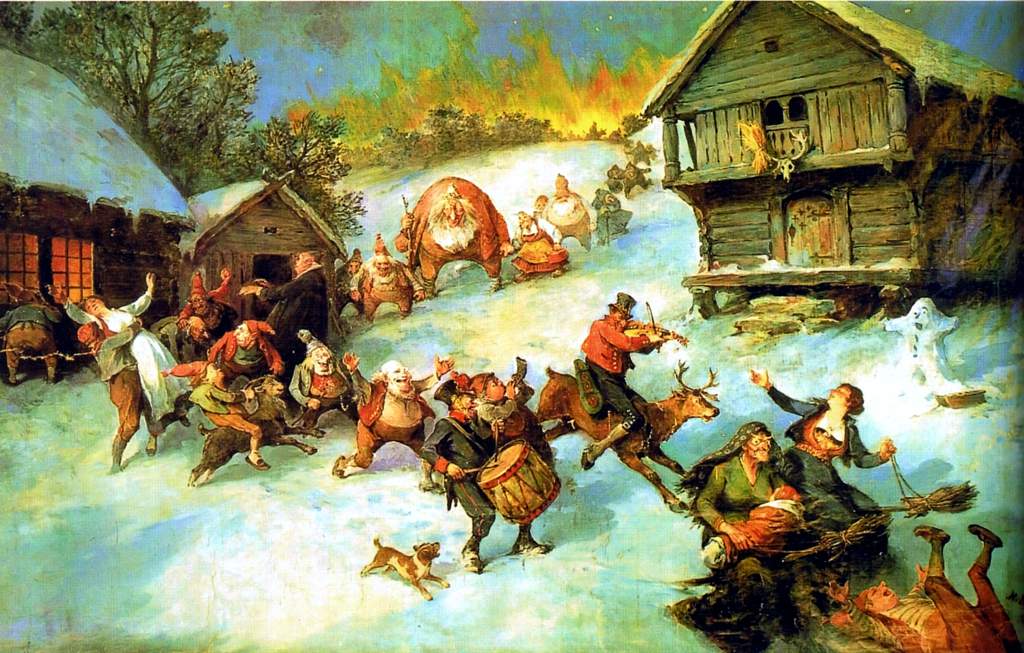
Nils Bergslien, Julereia, 1922: Lussi is shown stealing a child while riding her broom

================

Tis the season to be jolly, unless you enconter one of the most feared jul tide monsters,
and i'm not talking about Krampus... though a goat hooved, horned anti santa is not an ideal
Christmas guest ether lol.

 8 European Christmas Creatures That Will Give You Nightmares


=======

In the old days people believed that ghost both good and bad along with demons and monsters walked the earth and could interact with us  just the same as the living do. 


Winter was an especially feared time of the year, dark cold and bitter whether, shorter days and monsters to contend with, not exactly  a merry Christmas.


Winters in midevil Norway were dark and cold, and the myths and legends from the region are equally so.
 

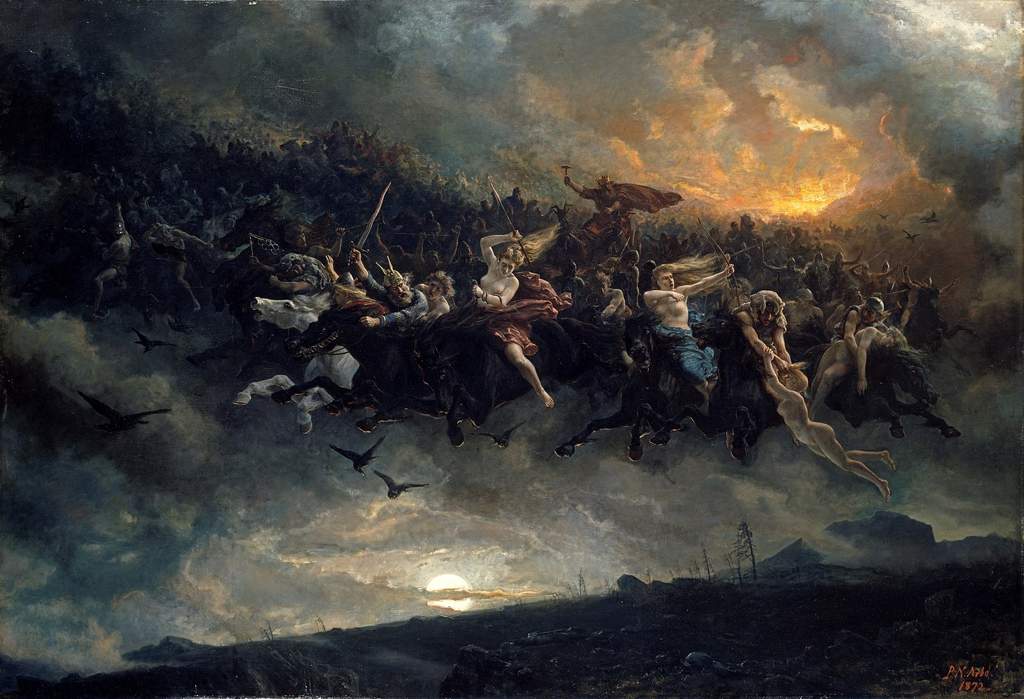
Just like the Germanic Wild Hunt, Lussi and her demon hordes would haunt the night, taking anyone they encountered during one of their nightly raids.
 

Starting December 13, in some versions this would go one all the way up until Jul/Yul.
 

 Norwegian superstitions: Åsgårdsreia, Lussinatt (night of Lussi), and  Fjøsnissen #OWC #AroundtheCampfire | Pagans & Witches Amino

The Wild Hunt. 


In the old Julian calendar the longest night of the year was December 13th.

Lussis night.

Lussi, Lussinatta, or just the Lussi Night, was marked on   December 13. when it was believed that  Lussi, a demoness or possibly  a powerful witch would ride through the cold winter night  with her minions, her and her followers,  called Lussiferda, Preying on  anyone foolish enough to be outside after the sun goes down, or anyone who had not finished their preparations for Jul.
 
Lussi was  also seen as a sort of anti-Santa, coming down the chimney to take away bad children. similar to Krampus a Germanic anti Santa that accompanied St. Nicholas and punished bad children.

Krampus - Wikipedia 


 Older triditions

This itself might be an echo of the myth of the Wild Hunt, called Oskoreia in Scandinavia, found across Northern, Western and Central Europe.

Between Lussi Night and The cow, trolls and evil spirits, and in some accounts even the spirits of the dead,  thought to be active outside.
It was believed to be particularly dangerous to be out during Lussi Night.

According to tradition, children who had done mischief had to take special care, since Lussi could come down through the chimney and take them away,
and certain tasks of work in the preparation for Yule had to be finished, or else the Lussi would come to punish the household.
The tradition of Lussevaka – to stay awake through the Lussinatt to guard oneself and the household against evil, has found a modern form through
throwing parties until daybreak. Another company of spirits was said to come riding through the night around Yule itself, journeying through the air,
over land and water.

There is little evidence that the legend itself derives from the folklore of northern Europe, but the similarities in the names ("Lussi" and "Lucia"),  and the date of her festival, December 13th, suggest that two separate traditions may have been brought together in the modern-day celebrations in  Scandinavia. Saint Lucy is often depicted in art with a palm as the symbol of martyrdom.,

==============


The best way to avoid meeting  monster Lussi was to stay up all night long, indoors with all the lights on.


In short, if you don't want to meet Lussi just say inside with a warm fireplace and a lot of light maybe some hot chocolate, and just  watch a good Christmas movie or something :)


=====================
=====================
St Lucia Day poem.

English

The long Lussi-night,
The long Lussi-night, nothing to be afraid of.
God protects farm and land,
The fishes in the water and the birds in the grove.
Nothing to be afraid of, the long Lussi-night.

The long Lussi-night, nothing to be afraid of.
Cows and horses and pigs and goats
will be healthy, round, and fat.
Nothing to be afraid of, the long Lussi-night.

The long Lussi-night, nothing to be afraid of.
Holy Mother of Good Christ,
free from death and the devil's list.
Nothing to be afraid of, the long Lussi-night.


=--=-=-=-=-=-=-=-=-=-=-=-=-=-=-=-=-
=-=-=-=-=In Norwegian=--=-=-=-=-=-=

Lussi-natti lange
Lussi-natti lange, intet være bange.
Gud beskytte gård og grund,
fisk i vand og fugl i lund.
Intet være bange, lussi-natti lange.

Lussi-natti lange, intet være bange.
Ku og hest og svin og geit
blive karske trinn og feit.
Intet være bange, lussi-natti lange.

Lussi-natti lange, intet være bange.
Hellige Moder gode Christ,
fri fra død og djevels list.
Intet være bange, lussi-natti lange.

===================


Merry Christmas and have a safe and fun new year everyone, hopefully 2021 will be a great year.