Showing posts with label England. Show all posts

Saturday, March 21, 2026

The Green Children of Woolpit


In old British Folklore there's a tale of two strange or even otherworldly children that suddenly appeared one day near the  village of Woolpit in Suffolk England.  

The kids wore odd cloths and  spoke an unknown language however the most noticable difference was there green skin.

As the story goes, One day   two children, a boy and a girl, were found near a pit, possibly a wolf pit/den, in the village of Woolpit in 12th century ..1135-1154 .


The sister seemed to be in better health then the brother.

At first they both refused to eat any food  offered to them besides broad beans , though they eventually,  learned to eat other foods, and soon after their skin became normal.

Not long after there discovery, the boy passed away. 

The girl later named Agnes adjusted to her new life, but she was considered to be "very wanton and impudent". After she learned to speak English, the girl explained that she and her brother had come from a land where the sun never shone, and the light was like twilight. According to one version of the story, she said that everything there was green; according to another, she said it was called Saint Martin's Land.


......


Full story, or at least the only two near contemporary accounts come from   William of Newburgh's Historia rerum Anglicarum and Ralph of Coggeshall's Chronicum Anglicanum, written in about 1189 and 1220, respectively.


-----------------------

At harvest time one day during the reign of King Stephen (r. 1135–1154), according to William of Newburgh, the villagers of Woolpit discovered two children, a brother and sister, beside one of the wolf pits that gave the village its name.

Their skin was green, they spoke an unknown language, and their clothing was unfamiliar. Ralph of Coggeshall reports that the children were taken to the home of Richard de Calne. Ralph and William agree that the pair refused all food for several days until they came across some raw broad beans, which they consumed eagerly. 

The children gradually adapted to normal food and in time lost their green colour.

 It was decided to Baptis the children, but the boy, who appeared to be the younger of the two, was sickly and died before or soon after baptism.


After learning to speak English, the children—Ralph says just the surviving girl—explained that they came from a land where the sun never shone and the light was like twilight. William says the girl called their home St Martin's Land; Ralph adds that everything there was green. According to William, the children were unable to account for their arrival in Woolpit; they had been herding their father's cattle when they heard a loud noise (according to William, it was like the sound of the bells of Bury St Edmunds abbey and suddenly found themselves by the wolf pit where they were found. Ralph says that they had become lost when they followed the cattle into a cave and, after being guided by the sound of bells, eventually emerged into our land.


According to Ralph, the girl was employed for many years as a servant in Richard de Calne's household, where she was considered to be "very wanton and impudent". William says that she eventually married a man from King's Lynn, about 40 miles (64 km) from Woolpit, where she was still living shortly before he wrote.

Based on his research into Richard de Calne's family history, the astronomer and writer Duncan Lunan has concluded that the girl was given the name 'Agnes' and that she married a royal official named Richard Barre.

To this day nobody really know where he kids actually came from, one theory is that they were Flemish immigrants and the green skin could be due to chlorosis, a condition caused by iron deficiency, which would clear with a healthier diet. As it later did 


Sunday, October 1, 2023

A church grim


 I have pre scheduled updates for every week this month Have an awesome Spooky Season 🎃 ...


        The Church Grim: Guardian of the dead


 A church grim is a guardian spirit from  English and Nordic/Scandinavian  folklore.


 Nordic Church Grim....

A Nordic church grim gose by different names depending on where its located .. the Kyrkogrim (Swedish), Kirkonväki (Finnish), and Kirkegrim (Danish) and likewise defined as the protective spirit of an animal buried alive in the church foundation. 

In Sweden this tradition  was  mainly found in the formerly Danish areas in the south (Scania, Halland, and Blekinge). It'is also connected with a creature called the "natteramm" in Scanian or, in English, "night raven".


 It usually lives in the church tower but will live any place on church grounds thsat it can stay hidden within., it also wanders the grounds at night, it's job is to with protect the sacred grounds and building. 

A church grim maintains  order in the church and punishes those  sinners that enters the hallowed grounds.

It 's said that the first founders of Christian churches would bury a lamb ("church-lamb") under the altar. When a person enters the church when services are not being held, he may see the lamb, and if it appears in the graveyard (especially to the gravedigger) then it portends the death of a child.

 In some older versions a lamb is said to have only three legs.

The lamb is meant to represent Christ (the Lamb of God) as the sacred cornerstone of the church, imparting security and longevity to the physical edifice and congregation.


Dogs are loyal faithful protectors which is why they where more commonly used as Church Grim's, but several other animals have been used  as well, the  most often used alternatives where a lamb, boar, pig and horse.

A grave-sow (or "graysow"), the ghost of a sow that was buried alive, was often seen in the streets of Kroskjoberg where it was regarded as an omen of death. 


There are tales of the Danish Kirkegrim and its battles with the Strand-varsler that tried to enter the churchyard. Strand-varsler are the spirits of those who die at sea, are washed up on the shore, and remain unburied.

In Swedish tradition, a person attempting the Årsgång, or year walk, a divination ritual that involved circling a churchyard on New Year's Eve, would have to contend with the church grim, which was the natural enemy of the year walker.

 ...........


                                                                The English Version.


England's  church grim is usually  a large black dog with red eyes that guards churchyards from  thieves, vandals, witches, warlocks, and even the Devil himself. 


In the 19th century, folklorists believed that it had once been the custom to bury a dog alive under the cornerstone of a church as a foundation sacrifice so that its ghost might serve as a guardian.

Like many spectral black dogs, the grim, according to Yorkshire tradition, is also an ominous portent and is known to toll the church bell at midnight before a death takes place. 


During funerals the presiding clergyman may see the grim looking out from the churchtower and determine from its aspect whether the soul of the deceased is destined for Heaven or Hell. 


The grim inhabits the churchyard day and night and is associated with dark stormy weather.

When a new churchyard was opened it was believed that the first person buried there had to guard it against the Devil. In order to prevent a human soul from having to perform such a duty a black dog was buried in the north part of the churchyard as a substitute.


 According to a related belief in Scotland the spirit of the person most recently buried in a churchyard had to protect it until the next funeral provided a new guardian to replace them.

This churchyard vigil was known as the faire chlaidh or "graveyard watch.


A folktale of the Devil's Bridge type is also an example of the motif of a dog (in this case a dog also named Grim) being sacrificed in place of a human being. In the North Riding of Yorkshire attempts were made to build a bridge that could withstand the fury of the floods but none were successful. 


The Devil promised to build one on condition that the first living creature that crossed it should serve as a sacrifice. When the bridge was complete the people gave long consideration as to who should be the victim. A shepherd who owned a dog named Grim swam across the river then whistled for Grim to follow, who went over the bridge and became the Devil's sacrifice.


The bridge then became known as Kilgrim Bridge  and was later renamed Kilgram Bridge, which today crosses the River Ure in North Yorkshire


Monday, March 9, 2020

Fairy Lore: Knockers's OR Tommyknockers


                                 Image result for tommyknocker
 Fairy Lore: The Knockers...

They are often said to live within the mines and can be dangerous or benevolent depending on who you ask..

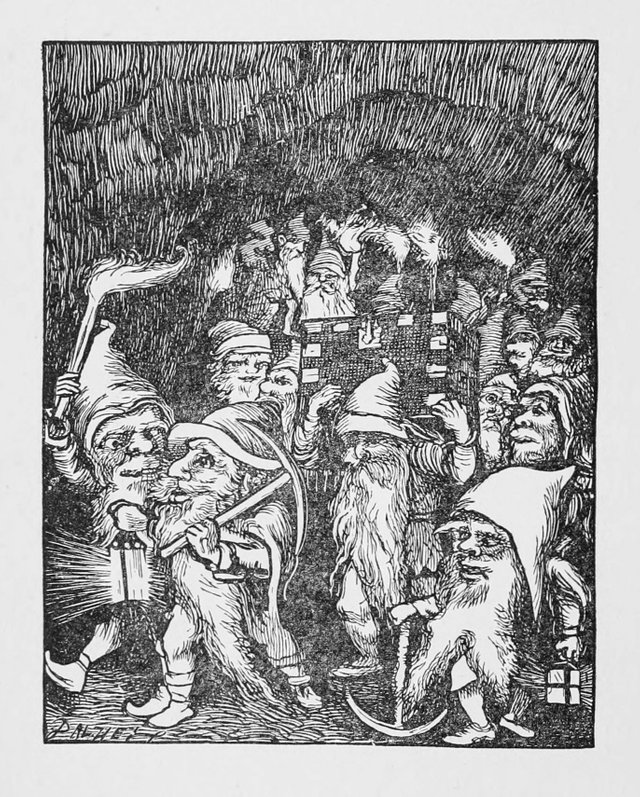
The Cornish described the creature as a little person two feet tall, with a disproportionately large head, long arms, wrinkled skin, and white whiskers. It wears a tiny version of standard miner's garb and commits random mischief, such as stealing miners' unattended tools and food.


 Other Names
The Knocker, Knacker, Bwca/bucca or Tommyknocker  is a mythical creature in Welsh, Devon and  Cornish mythology . It's closely related to the Kentish Kloker or the Irish Leprechaun .

In the 1820s, immigrant Welsh and Cornish miners brought tales of the tommyknockers and their theft of unwatched items and warning knocks to western Pennsylvania   when they relocated there to work in the mines.

The American gold rush brought people from all over the new world in search for gold , silver and untold wealth with there arrival is  California, Nevada and Colorado  tales of these subteranian dwelling little creatures soon began to rise.

 When asked if they had relatives who would come to work the mines, the Cornish miners always said something along the lines of "Well, me cousin Jack over in Cornwall wouldst come, could ye pay ’is boat ride", and so came to be called Cousin Jack.

The Cousin Jacks, as notorious for losing tools as they were for diving out of shafts just before they collapsed, attributed this to their diminutive friends and refused to enter new mines until assured by the management that the knockers were already on duty. Even non-Cornish miners, who worked deep in the earth where the noisy support timbers creaked and groaned, came to believe in the Tommyknockers. 

The American interpretation of knockers is somewhat  more ethereal or ghost like  than elvish.

                                            Image result for tommyknocker


Belief in the knockers in America remained well into the 20th century. When one large mine closed in 1956 and the owners sealed the entrance, fourth, fifth, and sixth generation Cousin Jacks circulated a petition calling on the mineowners to set the knockers free so that they could move on to other mines.


The owners complied. Belief among Nevadan miners persisted among its miners as late as the 1930s. 

 Tommyknocker Brewery in Idaho Springs  Colorado..owes its name to the mythical creature, and began serving in 1859 to meet the needs of the large number of prospectors, as part of the Colorado Sliver Boom. The brewery continues to operate and distributes nationally.
Knocker also appeared as a name for the same phenomena, in the folklore of Staffordshire miners.
 Image result for tommyknocker brewery

Image result for tommyknocker brewery


 Cornish Myth...
The Knockers  get there name  from the knocking sounds the make on the mine walls that happens just before cave-ins. (actually the creaking of earth and timbers before giving way.)

 To some miners, knockers were malevolent spirits and the knocking was the sound of them hammering at walls and supports to cause the cave-in. Other's  saw them as essentially well-meaning jocksters .

Some believed the knocking was their way of warning the miners that a life-threatening collapse was about to happen.

According to some Cornish folklore, the Knockers were the helpful spirits of people who had died in previous accidents in the tine mines,  and this was there way of warning the miners of impending danger. To give thanks for the warnings, and to avoid future danger  the miners would throw the last bite of their pastries into the mines for the Knockers.


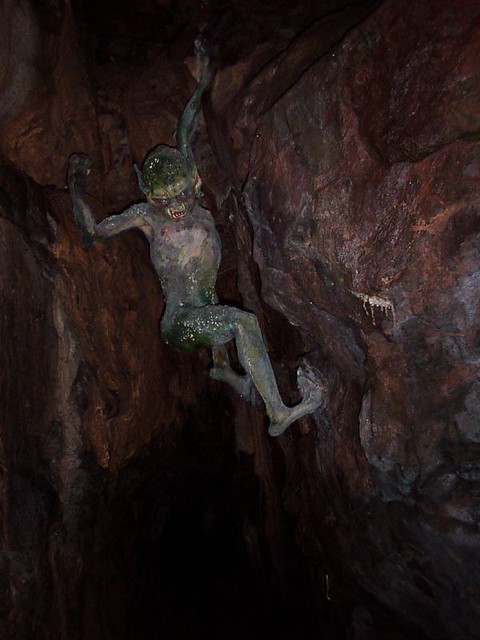
 Some described the knockers as human like in appearance other's say the are more goblin like...

                          Image result for tommyknocker

                                                   Chaddar cave demon

----------------------

One of the more well know iterations of this tale come from American Horror writer Stephen King and is story The Tommyknockers, later adapted into a movie.....Though they were depicted as aliens instead of supernatural beings


                                    Image result for tommyknockers tommyknockers

Image result for stephen king tommyknocker