Saturday, December 16, 2023

Mari Lewd 🐴💀👻


Mari Lwyd.

In short summary, the Mari Lewd is a Welsh myth about a horse headed creature that shows up during the twelve days of Christmas each year and goes door to door singing with a small Troup of followers trying to gain entry to your home to eat your food and drink your booze.


The Mari Lwyd is a wassailing folk custom that involves a giant horse's skull carried from house to house. It takes place in parts of Wales during the Christmas season.


The first recorded mention of Mari Lwyd comes from 1800s, in a book called ‘A Tour through Part of North Wales’ by J. Evans. However the tradition is actually more associated with Southern Wales, and towns like Glamorgan and Gwent.

Where the name ‘Mari Lwyd’ comes from isn’t entirely clear. It translates roughly to ‘grey mare’ with some thinking this is a reference to the prominence of pale horses in Celtic mythology. Folklorist Iowerth C. Peate thought it meant ‘Holy Mary’ referring to The Virgin Mary

.......


The Mari Lwyd goes from door to door with a group of followers, At each house they sing a song asking to come in. (Similar to modern Christmas  Carling) The occupants of the house sing back,  denying them entry at first, before eventually relenting. This back and forth is known as ‘pwnco’, and is an improvised battle of rhyme and verse.

Once the singers are allowed in they are given cakes and alcohol, the Mari Lwyd causes some mischief maybe frightening a few children in the process and everyone moves onto the next house.


Mari Lwyd was popular in the nineteenth century, thought it all but  disappeared from Wales by the beginning of the twentieth century. 

However, by the 1960s it had been revived in the town of Llangynwyd.


 From the 1970s onwards it appeared in more towns and villages across the country. Aberystwyth even marked the millennium by organising the world’s largest Mari Lwyd.


There are some similar traditions in England, such as Hoodening in Kent, or Old Tup in Nottinghamshire and Derbyshire. These also involved a horse’s head, a cloak, and going from house to house at Christmas time.


Wednesday, December 13, 2023

Winter Yokai: Oshiroi babā


❄️Oshiroi babā❄️

The white face powder hag.

This Yokai can be traced back at least as far as 1537.

Oshiroi babā are yokai that take the form of  old woman who appear in snowy mountainous areas near the end of the year. 

Oshiroi Baba (oshiroi; white face powder) +  (baba; old woman, hag). The word oshiroi specifically refers to the white face powder used by geisha and maiko.

She wears a tattered old kimono and a massive, straw umbrella hat covered in heavy snow,she carries a bottle of sake, usually a classic ceramic tokkuri and her face is covered in oshiroi powder, usually slathered on without  care for appearance.

Some claims say you will hear the sound of a mirror dragging and clattering abut from behind her as they hobble through the streets. Though the mirror is almost never actually seen.

 Her back is disfigured, twisted and bent like an old woman’s after a lifetime hard work. 


She carries a cane in one hand, and a sake bottle in the other, and wear a broken straw hat. 


Her most defining feature is their wrinkly old face caked with thick, sloppy, white face powder.

Oshiroi babā don’t tend to interact with humans too often. For the most part, their looks alone are  enough to ward if interactions.

 Though they will occasionally bother people, demanding makeup or trying to buy sake. In this way they are somewhat similar to other old hag yōkai who wander the streets at night, such as amazake babā. However, nearly every account of oshiroi babā describes them as hideous or scary, but not dangerous. 

Other version of the myth claims she appears on cold snowy nights and offer's warm sake to those in need.

According to some local legends, oshiroi babā are a variation of yuki onna. They leave the  mountains and wonder into villages on snowy nights.


 Others say they are more similar to yama uba, who sometimes demand makeup from travelers or can be found  at the bases of mountains trying to buy alcohol.


 According to Toriyama Sekien, oshiroi babā serve as the attendants of Shifun Senjō, the goddess of cosmetics which would explain the mirror, and make up requests.


❄️🍺🪞🧓🏔️


Monday, December 11, 2023

Drakavac


           Drekavac 


It's name means the screamer" or "the screecher,  as it's name would suggest its known for its distinctive and often terrifying scream.


The Drekavac is most often encountered  at night, especially during the twelve days of Christmas (called unbaptized days ) and in early spring, when other demons appear most often. 


It takes the form of the child, though deformed with elongated limbs and sometimes fur.

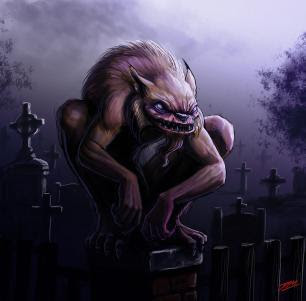
In other story's (especially more modern tellings) it usually resembles a dog like creature. However it can also assume other forms as well like a dappled foal, dog, cat, or bird or even a  human like being with glowing eyes. Other visions of the cryptid are described as a dog like beast that walks on its back legs, a long legged long necked animal with a cats head or an undead vampire like man that wonders the cemetery similar to a ghoul.


Originally believed to have come from the soul of a corrupt or sinful man, or from children who died unbaptized 

When seen in it's human form it looks like a child, and  predicts someone's death while in its animal form, it predicts cattle disease.

The Drekavac ether dislikes or fears dogs and is believed to avoid dogs and bright light.

 There is also a common belief that if the shadow of drekavac falls on someone then that person will become sick and eventually die.


In some regions it could be considered a type of boogyman, used to  scare kid's into behaving, in a similar way a the Boogeyman is in other places. 


It's also used as a scare tactic to keep smaller children from wandering to far from home. 

......


Other cryptids or monsters similar to a drakavac..


  • Bukavac – recorded in Syrmia, a six-legged monster with gnarled horns, slimy skin and long tail, that lives in water (rivers, swamps and creeks) and comes out of it during the night. It is known that it makes loud noises, and it will try to strangle people and animals that it encounters;
  • 👹👻🧛‍♀️
  • Jaud (pronounced [jaud]) – a vampirised premature baby.
  • 🧛‍♀️
  • Myling – from Scandinavian folklore, a phantasmal incarnations of the souls of unbaptized children that had been forced to roam the earth.
  • 👻
  • Nav – the soul of dead child that died before its third age.
  • 👻
  • Plakavac – recorded in Herzegovina, is a newborn strangled by its mother, which will rise from its grave at night as small vampire-like creature, return to its house and scream around it, but otherwise can't do any harm.
  • 🧟👻

  • Poroniec – a hostile and malicious demon from Slavic mythology. They were believed to come into existence from stillborn fetuses, but also from improperly buried remains of children who had died during infancy.

👹


Tuesday, December 5, 2023

Karampusnacht.🐐🎄


Krampusnacht is celebrated on December 5 every year across Germany, other European countries, and Austria. It's celebrated the night before the  Feast of St. Nicholas, a night when people dress up as the  Krampus and chase naughty children through the streets.       


 In the old stories St. Nicholas would travel with krampus on the night of December 5th.


He would rewards good children by leaving presents, Krampus would  beat those who are naughty with branches and sticks. In some cases, he is said to eat them or throgh them in his basket and take them to hell. 


In the 21st century, many Alpine countries continue to celebrate the Krampusnacht with parades, where the townsmen dress like devils and run through the streets chasing after children and naughty parents alike


If you hear hooves on the roof top tonight, it may not be reindeer lol


Friday, December 1, 2023

Norse God of Winter🌨️❄️


             ❄️Ullr❄️


Ullr, the Viking God of Winter 


He is the son of the grain goddess Sif, and the stepson of the thunder god Thor.


In chapter 31 of Gylfaginning in the Prose Edda, written in the 13th century by Snorri Sturluson, Ullr is referred to as a son of Sif (with a father unrecorded in surviving sources. 

He's a highly skilled  archer, hunter, skater, and skier.


Ullr - pronounced “ULL-er,” often Anglicized as “Ull,” and sometimes “Ullinn”)


In Grímnismál, it says his home is called Ýdalir, “Yew Dales.”


 He lives at his hall Ydalir, which translates to Yew Dales: yew wood was the material of choice for making bows in ancient Scandinavia. 


Ullr was also known as the god of oaths and combat. It's said that all oaths were taken on Ullr’s ring, which would shrink down to sever your finger should you break your oath.


In some versions of the myths his wife is the giantess Skadi....(in other stories, skadi is the wife of Njord The Sae God.)


 He was the ruler of Asgard when Odin was away for ten years.


There are several locations in Scandinavia  named after him. 


A few of the city's ...

Ullevål,

 Ullevi, 

Ullared, 

Ullensaker 

And Ullensvang..


Because of his status as a winter god, many worshippers would pray to Ullr before travel in the harsh northern winter.


Within the winter skiing community of Europe, Ullr is considered the Guardian Patron Saint of Skiers (German Schutzpatron der Skifahrer).

 An Ullr medallion or ski medal depicting the god on skis holding a bow and arrow, is widely worn as a talisman by both recreational and professional skiers as well as ski patrols in Europe and elsewhere.


Ever since 1963 the town of Breckenridge, Colorado has held a week-long "Ullr Fest" each January, featuring events designed to win his favor in an effort to bring snow to the historic ski town.


Ullr is also a playable character in the video game Smite.


.......


Can't believe its already December, time flys I guess, bundle up and enjoy the snow .

❄️☃️🎿⛷️


Thursday, November 23, 2023

Bakeneko the Demon Cat..


             -----------Bakeneko or Changing cat is a type of yokai (Sprite / demon) -----------


Cat's are often seen as sly and mysterious creatures..

Cats depicted as yōkai in Japan date back as far as the Kamakura Period  (1185–1333).

In the collection of setsuwa (oral tradition of folktales before the 14th century), the Kokon Chomonju   from this period, there are several descriptions of cats that do odd and suspicious things, noting that "these are perhaps ones that have turned into demons.
 ========================================

One of the more well know legends regarding a Bakeneko...
 is the story of Takasu Genbei...

 In this story  a man named Takasu Genbei, whose mother's personality suddenly changed  after his pet cat went missing for many years. His mother avoided interactions with old  friends and even family and would  often eat alone in her room. Untill one day when the family peeked in on her, they saw a cat-like monster in the mother's clothes, chewing on animal carcasses. Takasu, still skeptical, slew what looked like his mother, and after one day his mother's body turned back into his pet cat that had been missing. Takasu then tore up the floorboards of his mother's room to find her skeleton hidden there, her bones gnawed clean of all flesh.


=============================

  --------------------------------------------------

Folk lore:.....

The Bakeneko myths from arond Japan....


In Yamagata District, Hiroshima Prefecture, it is said that a cat raised for seven years or longer would kill the one that raised it. There are also many regions where when people began raising a cat, they would decide in advance for how many years they would raise it because of this superstition.

 Also, depending on the area, there are stories in which cats that were killed by humans in a brutal manner would become bakeneko and curse that human. The stories of bakeneko are not only about aged cats, but are also sometimes stories of revenge against cruel humans.

 
The abilities attributed to the bakeneko are various, but include shapeshifting into humans,  wearing a towel or napkin on the head and dancing, speaking human words,  cursing humans manipulating dead people, possessing humans  and lurking in the mountains and taking wolves along with them to attack travelers.

 As an unusual example, on Aji island, in  Oshika District, of the Miyagi Prefecture and in the Oki Islands, Shimane Prefecture, there's a story of a cat that shapeshifted into a human and wanted to engage in sumo.

 
However the legend of cats with the ability to speak, may have arisen because humans simply misinterpring the cat's meowing as human language, and for this reason some would say that the cat is not a type of yōkai. In 1992 (Heisei 4), in the Yomiuri newspaper, there was an article that argued that when people thought they had heard a cat speak, upon listening a second time, they realized that it was simply the cat's meowing and that it was only coincidence that it resembled a word in human language.

In the Edo period (1603–1867), there was a folk belief that cats with long tails like snakes could bewitch people. Cats with long tails were disliked and there was a custom of cutting their tails. It is speculated that this is the reason that there are so many cats in Japan with short tails nowadays, because natural selection has favored those with short tails.

Folk beliefs that cats can cause strange phenomena are not limited to Japan. For example, in Jinhua, Zhejiang, in China, it is said that a cat, after having been raised for three years by humans, would then start bewitching them. Because it is said that cats with white tails are especially good at this, there arose the custom of refraining from raising white cats. Since it is said that their ability to bewitch humans comes from taking in the spiritual energy of the moon, it is said that when a cat looks up at the moon, whether its tail has been cut or not, it should be killed on the spot
===============================
======================
=================


The reason that cats are seen as yōkai in Japanese mythology is attributed to many of the characteristics that they possess: for example, the way the irises of their eyes change shape depending on the time of day, the way their fur seems to cause sparks due to static electricity when they are petted (especially in winter), the way they sometimes lick blood, the way they can walk without making a sound, their wild nature that remains despite the gentleness they can show at times, the way they are difficult to control (unlike dogs), the sharpness of their claws and teeth, their nocturnal habits, and their speed and agility.


There are many yōkai animals other than cats in old tales that have similar attributes: the deep tenacity of snakes, the ability of foxes (kitsune) to shapeshift into women, and the brutality of tanuki in eating humans depicted in the Kachi-kachi Yama folktale from the Edo period. Cats in particular, however, have acquired a great number of tales and superstitions surrounding them, due to the unique position they occupy between nature and civilization.

As cities and towns were established and humans began living farther apart from nature, cats came with them. Since cats live close to humans yet retain their wild essence and air of mystery, stories grew up around them, and gradually the image of the bakeneko was formed.
 
One folk belief concerning the bakeneko is that they would lick the oil of oriental lamps, and in the Edo period encyclopedia, the Wakan Sansai Zue, it is said that for a cat to lick this oil is an omen of some strange event about to occur.

 People in the early modern period used cheap oils from fish, like sardine oil, in the lamps, and that could explain why cats would want to lick them.

 The diet of most  Japanese people at that time was based primarily on grains and vegetables, and the leftovers would be fed to the cats.

 However, since cats are carnivores, such a diet would have been lacking in protein and fat, and therefore they would have been even more attracted to the oil in the lamps.

Furthermore, the sight of a cat standing up its hind legs to reach the lamp, with its face lit up and eyes round with anticipation, could have seemed eerie and unnatural, like a yōkai.

The mysterious air that cats possess was associated with the image of prostitutes who worked in the Edo period red-light districts. This was the origin of a popular character in kusazōshi (among other publications), the bakeneko yūjo


Monday, November 20, 2023

Otakemaru : The Great Mountain Peak


 Otakemaru

Also called 

The great mountain peak”


Otakemaru is a kijin— an oni so powerful and so violent that he is considered both demon (ki) and god (jin).

He lived in the Suzuka Mountains on the border of Ise and Omi Provinces during the reign of Emperor Kanmu (781 to 806).

Although his legend is not so well-known today, he was once considered among the most fearsome yokai in Japanese history.

Along with Shuten doji and Tamamo no Mae, he is often considered one of the Nihon san dai aku yokai, or Great Three Evil Yokai of Japan.  (Some versions of this ranking replace Otakemaru with Sutoku Tenno.)


Because of the time period and locations in which his story takes place, and the fact that his chief enemy was the shogun Sakanoue no Tamuramaro,  it is thought that Otakemaru may be a folkloric interpretation of Aterui, a chieftain of the Emishi people of northeastern Japan who waged a devastating campaign against the Yamato Japanese.

His legend also serves as the basis of Aomori Prefecture’s famous Nebuta Matsuri, in which large floats depicting warriors defeating oni are parading through the streets.

.....'.'.......

Long ago an oni named Otakemaru terrorized travelers in the Suzuka Mountains and stole tributes intended for the emperor in Kyoto.
 

The emperor commanded his shogun, Sakanoue no Tamuramaro, to exterminate the demon.

Tamuramaro raised an army of 30,000 horsemen and entered the Suzuka Mountains.

However, Otakemaru was powerful, and using his black magic  he summoned a great storm. He covered the mountains in black clouds, making it impossible to see. Rains and winds battered the army.
Lightning crashed and fire rained down from the sky onto the army. For seven long years Tamuramaro and his men roamed the mountains in  search of Otakemaru, but could not catch him.

The Suzuka Mountains were home to a tennyo—a beautiful goddess named Suzuka Gozen.

When Otakemaru saw her, he was enchanted by her beauty and became determined to spend a night in her company.

He transformed himself into a beautiful young man, a noble of the court, and other disguises, and night after night traveled to Suzuka Gozen’s  palace. 

 But every time, his solicitations were denied by the goddess.

Frustrated by his inability to find the Otakemaru’s whereabouts, Tamuramaro prayed to the gods and the buddhas to help him. That night, as  he dozed off, he had a vision of an old man. “To defeat Otakemaru you must gain the help of Suzuka Gozen,” the old man told him. Tamuramaro  sent his army of 30,000 horsemen back to Kyoto and climbed the Suzuka Mountains by himself. Deep in the mountains, he came upon a palace in  which lived a beautiful woman. She invited him inside, and he spent the night with her. The woman told Tamuramaro, “I came down from heaven to help you defeat the demon who haunts these mountains. I will capture him for you.” Tamuramaro realized that this beautiful woman must be Suzuka Gozen.

Suzuka Gozen led Tamuramaro through the mountains to show him the Otakemaru’s demon castle.

She instructed him that Otakemaru could be defeated while he possesses the Sanmyo no ken (Kenmyoren, Daitoren, and Shotoren: three holy swords of  great power). Then they traveled back to her palace, where she laid her trap for the oni.

The night, Otakemaru came to her again, disguised as usual as handsome young man to ask for her love. Suzuka Gozen invited him inside, and said to him ..A warrior named Tamuramaro is coming here to kill me. Please, lend me the Sanmyo no ken so that I may defend myself.”
 

The oni gave her Daitoren, and Shotoren to defend herself with, but kept Kenmyoren for himself.

The following night Otakemaru came once again to Suzuka Gozen’s palace. 


Tamuramaro was waiting for him there. Otakemaru revealed his true form to the  shogun, transforming into a massive demon who stood over 10 meters tall, with eyes that shined like the sun and the moon. A terrible combat ensued. 


Heaven and earth shook with the fury of their battle. Otakemaru attacked Tamuramaro with sword and spear, but the shogun was a holy warrior,  protected by the thousand-armed Kannon, bodhisattva of mercy, and Bishamonten, god of war. Otakemaru split his body into thousands of oni, who  charged at Tamuramaro. Tamuramaro took from his quiver a single holy arrow and fire it, The arrow split into one thousand arrows which in turn  split into ten thousand more and impaled the oni in their faces, killing them. Just then, Otakemaru made a ferocious lunge at Tamuramaro. But the shogun was faster, and he swung his blade Sohaya at the oni’s head, lopping it off.

Tamuramaro brought the oni’s head back to Kyoto for the emperor to inspect. 

The emperor was so pleased with the shogun that he granted him Iga

Province as a reward. Tamuramaro returned to Iga, married Suzuka Gozen, and the two of them lived happily together for many years.

Otakemaru’s reign of terror, however, was not over. His spirit traveled to India for a time, and eventually returned to Japan and haunted Kenmyoren. 

 
He was able to reform his body and once again became a kijin. He rebuilt his impregnable demon castle on Mount Iwate in Mutsu Province and once again he began to terrorize Japan.

Tamuramaro and Suzuka Gozen traveled to Mutsu to meet their nemesis one more time and defeat him once and for all. While Otakemaru was away from his castle, Tamuramaro snuck in through a secret back door that Suzuka Gozen had revealed to him in Otakemaru’s first demon castle. When Otakemaru  returned, Tamuramaro was waiting for him. They did battle, and once again Tamuramaro cut Otakemaru’s head clean off. 

The oni’s head flew up into the air and landed upon Tamuramaro’s head and bit down hard. Fortunately, Tamuramaro was wearing two helmets. Though the demon head bit off and swallowed the first one, Tamuramaro was able to escape injury. 

Otakemaru’s head was once more taken back to Kyoto, where it was locked safely away in the treasury
of Byodoin.