Showing posts with label siren. Show all posts

Sunday, February 8, 2026

German Folklore, Lorelei The Siren..


Lorelei.


In German Folklore Lorelei is described as a beautiful golden haired siren that site's on top of a large rock on the banks of the Rhine River and sings her beautiful and bewitching melodies to lure sailors to their death.


As the legend goes, she was once a beautiful young woman, who  in a moment of despair over a cheating lover claimed the rock and threw herself into the river.

She was then   transformed into a siren who lured fishermen and sailor's to their doom 


 The large rock also called Lorelei, stands on the edge of the Rhine River near Sankt Goarshausen, Germany, and is also known for producing an echo. 


The essentials of the legend itself was created by German writer Clemons Brentano in his ballad “Zu Bacharach am Rheine” (“To Bacharach on the Rhine”), which first appeared in his novel Godwi (1800–02). 

Lorelei became the subject of a number of literary works and songs; the poem “Die Loreley” (1824) by Heinrich Heine was set to music by more than 25 composers.


Part of the song.

The comb she holds is golden,

She sings a song as well

Whose melody binds an enthralling

And overpowering spell.

In his little boat, the boatman

Is seized with a savage woe,

He’d rather look up at the mountain

Than down at the rocks below.

From The Lorelei English translation of the poem by Heinrich Heine, 1824. Translated by A.Z. Foreman


The waves of the river and a nearby waterfall combined with the natural echo of the location create a murdering sound that many attribute to the sirens song.

The legend and song have lead to this rock becoming a tourist destination. And a statue of Lorelei has been placed at the top.


Friday, March 12, 2021

Monsters, Cryptids and Yokai, Russian folklor, Alkonost, Gamayun and Shishiga


 ......................Today's post is mostly Russian based siren and harpy like cryptids.................


pic is by Viktor Vasnetsov's Sirin (left) and Alkonost (right) Birds of Joy and Sorrow (1896)

==========================

Russian myths..

The Alkonost, Gamayun and Shishiga..

================================================


In  Russian folklore the Alkonost is a woman-headed bird similar to the Greek Sirens
dangerous creatures, who lured nearby sailors with their enchanting music and singing voices
to shipwreck on the rocky coast of their island..

Like the sirens the Alkonost is said to have a beautiful voice and those who hear these sounds
forget everything they know and want nothing more ever again.

The Alkonost lays her eggs on a beach and then rolls them into the sea. When the  eggs hatch, a thunderstorm
sets in and the sea becomes so rough that it's impossible to traverse.
She is also related to other birds like beings in Slavic mythology, namely the Rarog and Stratim.

The name Alkonost is derived from a Greek demigoddess named Alcyone.

In Greek mythology, Alcyone was transformed by the gods into a kingfisher....
==========


The Gamayun...

the Gamayun is usually depicted as a large bird with a woman's head, again simiar to the sirens.

Like the Alkonost, the gamayun is believed to originate from the Greek folklore and siren mythology.

However unlike the dangerous and often malevolent sirens, the Gamayun is a being of prophecy in Russian folklore. She  is a symbol of wisdom and knowledge.

She is said to live on an island in the mythical east, close to paradise.

According to legends she spread divine messages and prophecies, and she knows everything of all creation,  gods, heroes, and man.


........
 and our third cryptid is the Shishiga..


Shishiga are  sometimes called leshenka .


She is a female swamp (or forest) creature similar to the wood-goblin.


She  is often  described as, white, nude, and has tousled  hair.

She is known to harass people and bring misfortune to the drunkards.

She is also an  important figure in the mythology of the Komi people.

The Shishiga supposedly lives in the Kama River and often goes to the shore to comb her hair.

Seeing her is considered a very bad omen, as those who do sees her will soon drown or die by another cause.


The Shishiga also shares some similarity to the story of Artemis and Actaeon from  Greek mythology..


.........

.....

...


Friday, February 14, 2020

Demon of love: The Succubus..


                                                        ------------------------------------------------
                                                             ...🖤Happy Valentines Day 🖤....
                                                             ---------------------------------------


                                 Ecchi Succubus demon anime girl by Rezifound on pintreist...

                                                         =============
                                   ---Succubus---
                                       ======== 

Succubus or (Sucubi) are powerful female demons commonly associated with sexual desire..

The Succubus is referenced in midevil European folklore and ancient  Jewish mythology.

In a biblical account Lilith the first woman and  Adam's fist wife turned into a demon (Succubus) after leaving the Garden of Eden., and later became the queen of Demons and one of the for Queens of the succubus.

In the Kabbalah  and the school of Rashla, the original three queens of the demons, Eisheth Zenumin, Naamah, and Agrat bat Mahlat. and all their cohorts give birth to children, except Lilith  According to other myth's, the children of Lilith are called Lilin.


The four queens of the Succubus are ...   Lilith, Eisheth Zenumin, Agrat bat Mahlat, and Naamah.

The word succubus comes from Latin...succuba "paramour"; from succubare "to lie beneath" (sub- "under" and cubare "to lie") used to describe this female entity's implied sexual position relative to the male sleeper's position.

The word succubus originates from the late 14th century (late 1,300's).


Succubi are female daemon's that appeal to a man's sexual fantasy's/dreams  they can take on various sexually appealing forms.

From long haired, to lithe and winged.

Succubi appear in whatever form is most pleasing to her intended victim.

Though they commonly appearing as scantily clad, shapely, winged demons.


===============


In some legends a Succubi true form were described as being disfigured and monsters, with multiple of rows of teeth, 3 sets of breasts and razor sharp  talon-like nails.

Though the  descriptions vary from legend to legend.

 ----------------


                                            Myth's regarding Succubi date back century's..

Victims of 'Succubi' attack's described their visits as a feeling of someone sitting on my chest or pelvic area.' and when they wake up , they feel drained, unable to move and petrified, though having had a wonderful and erotic dream the night before.

This is likely a form of sleep paralysis..

In medevil time's  succubi encounters were sometimes used  as an attempt to explain why some people had birth defects or as an excuses for  adultery.

 Succubus are said to  use there supernatural powers to seduce a man and steal his semen.
In some versions of the legend Succubus would later  transform into an Incubus and seduce a woman. 
After a woman has an encounter with  an incubus the baby might have some form  deformities or other supposed marks of the demons influence. 

Characteristically, a Succubi is a psychic, or 'manipulative' demon, using manipulation and compelling psychic abilities to overcome and seduce its prey, feeding from the victims soul and returning night after night until the soul is entirely consumed, resulting in the mans death..
-------
---------------


The Sirens of Greek mythology are similar in nature to a succubus, in that they use there attractive form's and mesmerizing song's to lure men to there death's..


-----------------------------------------------------------------------------------
                                  The Odyssey - Homer ’s 8th century BCE about
Odysseus (known as Ulysses in Roman myths), king of Ithaca, and his journey home after the fall of                    Troy. along the way he and his crew encounter Sirens...
              Image result for sirens


                                           Image result for sirens


=======
Succubus in other media..
--------------
 Morrigan from  Darkstalkers, by Capcom

                                         morrigan_by_artgerm https://www.deviantart.com/artgerm/art/Morrigan

 ============
Interviews with Monster Girls --- Demi-Chan wa kataritai-- anime ..

Sakie Satou--

===============
Maria the Virgion Witch - Janketsu no Maria --

 Artemis

===================
 Rosario  to Vampire

Ageha Kurono
 =============
Highschool DxD
Rias Gremory 

 ===============
Manga Series--
Shachiku Succubus no Hanashi
Lily--


 ===============
🖤. 🖤.Happy Valentines Day🖤.🖤. .

=========================
 

Tuesday, August 27, 2019

The Naiad; Water Nymph


                                                                      Naiad


The Greek word is Ναϊάς  Naiás, pronounced na͜a.i.ás, plural Ναϊάδες  Naiades,  (na͜a.i.ád.es) It derives from νάειν (náein), "to flow", or νᾶμα (nãma), "running water". "Naiad" has several English pronunciations.. ˈneɪæd neɪəd,  naɪæd, naɪəd.

In Greek mythology, the Naiads (Ancient Greek: Ναϊάδες) were a type of water nymph (female spirit) who presided over fountains, wells, springs, streams, brooks and other bodies of fresh water.  They are distinct from river gods, who embodied rivers, and the very ancient spirits that inhabited the still waters of marshes, ponds and lagoon-lakes, such as pre-Mycenaean Lerna in the Argolid.

Naiads were associated with fresh water, as the (Oceanids) were with saltwater and the Nereids specifically with the Mediterranean, but because the Greeks thought of the world's waters as all one system, which percolated in from the sea in deep cavernous spaces within the earth, there was some overlap. Arethusa, the nymph of a spring, could make her way through subterranean flows from the Peloponnesus, to surface on the island of Sicily.

                                               It is considered a bad omen to capture a naiad


They were often the object of archaic local cults, worshiped as essential to humans. Boys and girls at coming-of-age ceremonies dedicated their childish locks to the local naiad of the spring. In places like Lerna their waters' ritual cleansing were credited with magical medical properties. Animals were ritually drowned there. Oracles might be situated by ancient springs.

Naiads could also be dangerous,  Hylas of the Argo's crew was lost when he was taken by naiads fascinated by his beauty...

 The naiads were also known to exhibit jealous tendencies. Theocritus' story of naiad jealousy was that of a shepherd, Daphnis, who was the lover of Nomia or Echenais; Daphnis had on several occasions been unfaithful to Nomia and as revenge she permanently blinded him. Salmacis forced the youth Hermaphroditus into a carnal embrace and, when he sought to get away, fused with him.  The water nymph associated with particular springs was known all through Europe in places with no direct connection with Greece, surviving in the Celtic wells of northwest Europe that have been rededicated to Saints, and in the medieval Melusine.

Walter Burkert points out, "When in the Iliad  Zeus calls the gods into assembly on Mount Olympus, it is not only the well-known Olympians who come along, but also all the nymphs and all the rivers; Okeanos alone remains at his station  hearers recognized this impossibility as the poet's hyperbole, which proclaimed the universal power of Zeus over the ancient natural world: "the worship of these deities," Burkert confirms, "is limited only by the fact that they are inseparably identified with a specific locality.


In another legend a mythic king is credited with marrying a naiad and founding a city: it was the newly arrived Hellenes justifying their presence. The loves and rapes of Zeus, according to Graves' readings, record the supplanting of ancient local cults by Olympian ones (Graves 1955, passim). Fountain of the Naiads, Piazza della Repubblica, Rome, Italy  So, in the back-story of the myth of Aristaeus, Hypseus, a king of the Lapiths, married Chlidanope, a naiad, who bore him Cyrene.

 Aristaeus had more than ordinary mortal experience with the naiads: when his bees died in Thessaly, he went to consult them. His aunt Arethusa invited him below the water's surface, where he was washed with water from a perpetual spring and given advice.   

St. Charles Avenue in New Orleans was formerly known as Nyades Street, and is parallel to Dryades Street.       


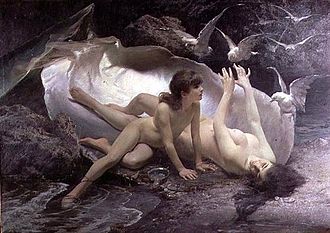
                                              Gioacchino Pagliei The Naiads 1881


Types of Naiad
 
Crinaeae (fountains)   
Eleionomae (marshes)   
Limnades or Limnatides (lakes)   
Pegaeae (springs)   
Potameides (rivers) 

Diferent kinds of Nymph         
Alseid   
Auloniad   
Aurai   
Crinaeae   
Dryads   
Eleionomae   
Hamadryads   
Hesperides   
Limnades   
Lampads   
Meliae.   
Naiads   
Napaeae   
Nereids   
Oceanids   
Oreads   
Pegaeae   
Pegasides   
Pleiades   
Potamides  
  

Other Water Types  
   
Camenae   
The Lady of the Lake   
Melusine   
Mermaid   
Nix   
Ondine   
Rusalka   
Siren